
Advances in Therapy
Cure8 research brief
Cure8 research brief
This study models comparative cost-effectiveness across many advanced therapy sequences for moderate–severe ulcerative colitis in Japan; its findings could influence how health systems and clinicians consider first- and second-line choices among newer agents like etrasimod and upadacitinib.
Clinicians, health-system decision makers, researchers, and patients interested in advanced therapy sequencing or drug-cost/value considerations for ulcerative colitis in Japan.
This modeling study compared cost-effectiveness of 79 advanced treatment sequences for moderately to severely active ulcerative colitis in Japan.
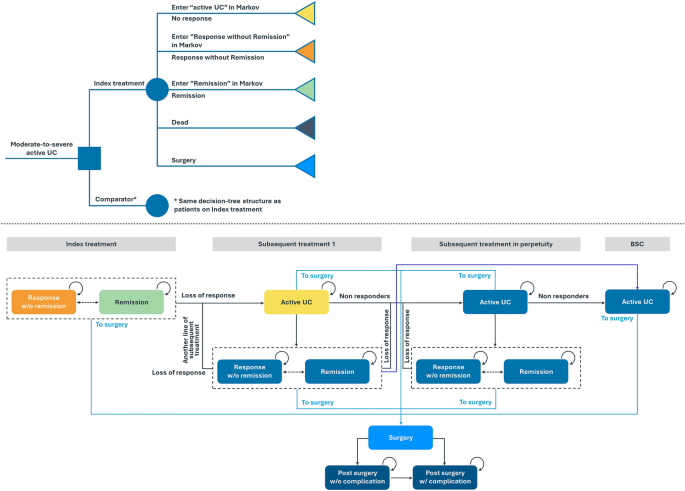
Using a hybrid decision-tree + Markov model adapted to Japanese practice, the authors report that first-line etrasimod followed by second-line upadacitinib was the most cost-effective sequence under the study's assumptions and the Japanese willingness-to-pay threshold.
The analysis included multiple available advanced therapies (oral S1P modulators like etrasimod and ozanimod; JAK inhibitors including upadacitinib and tofacitinib; biologics such as anti-TNF agents adalimumab, golimumab, infliximab; vedolizumab; and ustekinumab) and modeled lifetime clinical and economic outcomes with treatment switching rules.
Results are model-based and intended to inform sequencing considerations alongside clinical judgement, safety, and patient preferences.
Key limitations noted by the authors include reliance on network meta-analysis inputs, model assumptions about treatment effects and sequencing, and adaptation to the Japanese healthcare setting; real-world effectiveness, safety, and individual patient factors can change optimal choices.
These are model-based findings using published trial/network-meta inputs and Japanese cost parameters; they do not replace individualized clinical decision-making. The analysis depends on assumptions about treatment effects, switching rules, and costs; results may differ with new data or in other healthcare settings.
Review the original publication for the complete reporting, methods, and context.
Funding disclosed by the source: Pfizer Japan
This Cure8 brief is based on source text from the linked article. Cure8 is informational only and is not a substitute for professional medical advice, diagnosis, or treatment.
This study compares many targeted IBD drugs indirectly to help clarify how subcutaneous vedolizumab stacks up against other biologics and newer oral therapies — information that could inform treatment discussions for...
For people with multi-refractory Crohn’s disease or ulcerative colitis, adding a JAK inhibitor to an existing biologic (advanced combination therapy) may convert partial responses into deeper remission in selected cases,...
Switching biologics is a frequent and consequential decision in children with IBD; using TDM and a mechanism‑based approach can help choose whether to optimize, switch within class, or change drug class.