Identifies a microbiome-derived protein that inhibits a protease linked to epithelial damage in IBD and shows protective effects in lab and mouse models, pointing to a new therapeutic strategy focused on barrier protection.
Who Should Pay Attention
Researchers (microbiome, drug discovery), clinicians interested in new IBD therapies, and patients tracking microbiome-based research
Study Snapshot
Story typeResearch paper
Evidence typeResearch paper
Source depthJournal abstract
What To Know
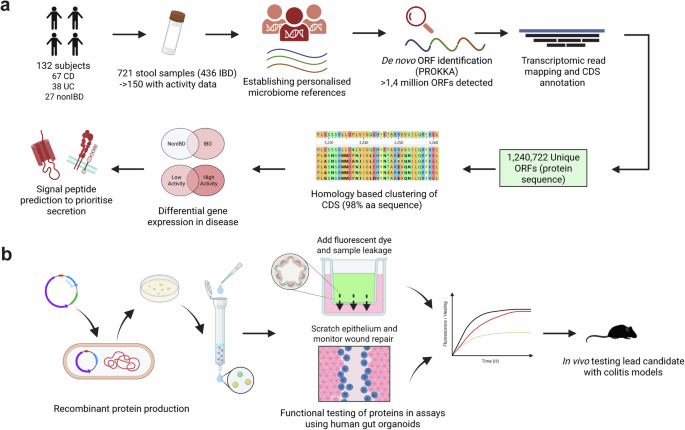
Researchers screened microbial gene expression data to identify bacterial proteins with bioactivity relevant to IBD. They produced and tested one candidate, BMG-1, showing it blocks neutrophil elastase — a protease implicated in epithelial injury — and that this inhibition preserved barrier integrity in experimental systems.
In mice with chemically induced colitis, treatment with BMG-1 lowered colon damage compared with controls. The authors also report that levels of the native BMG-1 protein are lower in stool from patients during higher IBD activity.
This work is framed as a proof-of-concept that microbiome-derived proteins can be drug leads to protect the intestinal barrier, not as a ready therapy.
Keep In Mind
Summary is based on the article abstract (structured-content depth: abstract). Findings are preclinical (lab and mouse) with an observational stool association in humans; this is not evidence that a therapy is safe or effective in patients yet.
Source Details
Review the original publication for the complete reporting, methods, and context.
This Cure8 brief is based on source text from the linked article. Cure8 is informational only and is not a substitute for professional medical advice, diagnosis, or treatment.
The study identifies a previously unrecognized protein (TNFAIP1) that appears to promote inflammation in ulcerative colitis and proposes a compound (Salidroside) that directly binds and inhibits it in lab and mouse...
ER stress in intestinal epithelial cells is proposed as a key molecular mechanism in UC development; targeting ER pathways (notably IRE1β) could eventually lead to new treatments that strengthen the gut barrier and...
The study suggests a plant-derived AHR-activating mechanism that reduced inflammation and repaired the intestinal barrier in preclinical ulcerative colitis models, a pathway that could be relevant to future therapies or...