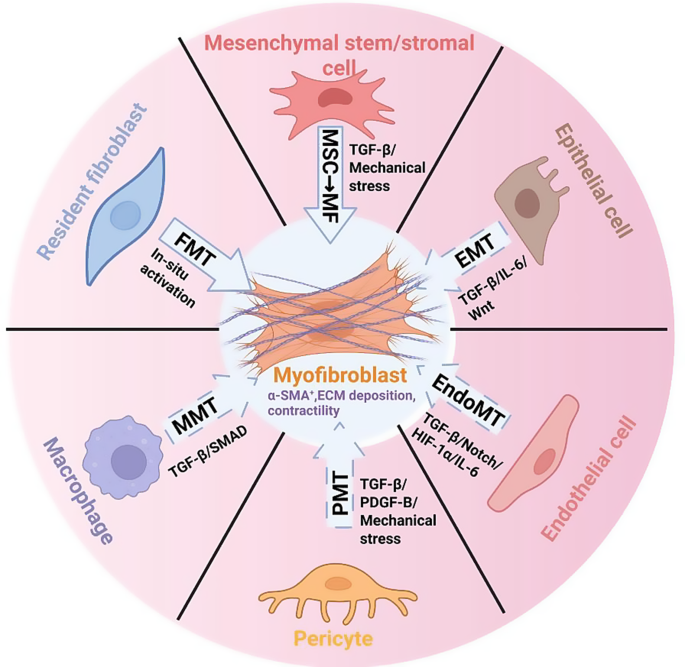
Sustained fibroblast-to-myofibroblast transition (FMT) is linked to intestinal fibrosis and tumor-related stromal changes that can worsen outcomes in IBD. Understanding the cellular crosstalk that drives FMT could point to new therapies to prevent or reverse fibrosis and pathological remodeling in the gut.
Who Should Pay Attention
Researchers in intestinal stromal biology; clinicians managing IBD with fibrosis risk; translational scientists developing microenvironment-targeting therapies.
Study Snapshot
Story typeResearch paper
Evidence typeResearch paper
Source depthJournal abstract
What To Know
This review examines fibroblast-to-myofibroblast transition (FMT) in the intestinal tract and how intercellular signaling and the tissue microenvironment control FMT during normal repair and in disease.
It summarizes mechanisms by which sustained FMT and stromal remodeling can drive intestinal fibrosis and tumor-associated stromal changes, links those processes to inflammatory bowel disease (IBD) and related complications, and discusses emerging therapeutic strategies aimed at targeting cellular interaction networks to remodel pathological stroma.
The article is a review (abstract-level content provided) focused on basic and translational biology rather than clinical trial results.
It highlights FMT as an active reprogramming event influenced by temporal and spatial coordination among intestinal cells, and it frames targeting cell–cell dialogs and the microenvironment as potential avenues to limit fibrosis and tumor-promoting stromal remodeling.
Because the supplied content is an abstract-level review, it does not present new clinical trial outcomes or specific approved drug recommendations; instead it surveys mechanisms and emerging therapeutic concepts.
Keep In Mind
Structured content depth: abstract — the supplied text is an abstract-level review. The article summarizes mechanisms and emerging therapeutic ideas but does not present new trial results in the provided excerpt.
Source Details
Review the original publication for the complete reporting, methods, and context.
This Cure8 brief is based on source text from the linked article. Cure8 is informational only and is not a substitute for professional medical advice, diagnosis, or treatment.
The review links gut microbiota changes and mucosal immune responses across IBD and IgA nephropathy, suggesting that gut dysbiosis may contribute to systemic immune-driven disease.
Intestinal fibrosis causes strictures that often need surgery and has few effective medical treatments; linking the microbiome to fibrogenesis suggests new prevention or treatment strategies that could reduce surgery...
The study identifies Piezo1 in intestinal epithelial cells as a potential driver of intestinal fibrosis in IBD via a stiffness → ROS → partial EMT pathway, and suggests targeting Piezo1 or ROS could reduce fibrosis in...