Current Surgery Reports
Cure8 research brief
Cure8 research brief
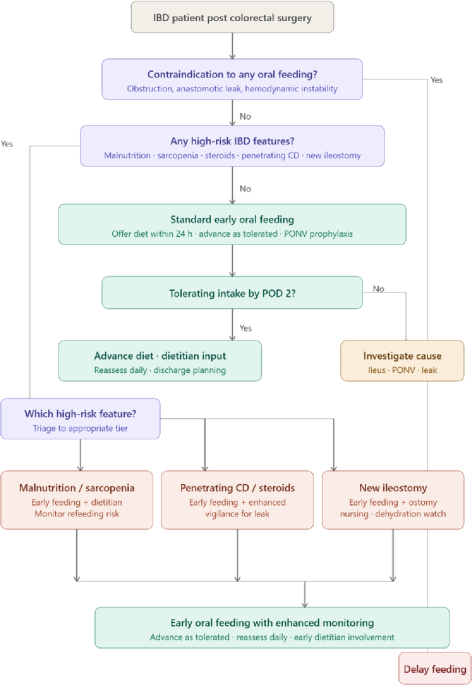
Early feeding after colorectal surgery can speed recovery and shorten hospital stay and appears safe for most patients with IBD when used within ERAS programs.
People with Crohn’s disease or ulcerative colitis often have higher inflammation, steroid exposure, or malnutrition, which may call for individualized monitoring rather than routine delayed feeding.
Patients with IBD (Crohn’s disease or ulcerative colitis) facing colorectal surgery; surgeons and perioperative teams using ERAS pathways; dietitians and postoperative care clinicians; researchers studying surgical outcomes in IBD.
This review article summarizes evidence that early oral feeding (within 24 hours) after colorectal surgery — including operations for IBD — is generally safe and shortens hospital stay and bowel recovery when used inside enhanced recovery after surgery (ERAS) pathways.
The authors note randomized-trial evidence in general colorectal populations and more limited, disease-specific randomized trials in IBD; available cohort studies and consensus guidance support early feeding for most IBD patients, with careful monitoring for those with high inflammatory burden, recent steroid or immunosuppressant exposure, or malnutrition.
The paper emphasizes that although IBD patients have higher baseline anastomotic leak risk than many cancer patients, there is no evidence that delaying oral intake reduces that risk; instead, individualized modifications and enhanced monitoring are advised for high-risk cases.
The authors call for IBD-specific feeding trials in high-risk subgroups and for implementation research to close gaps between guidelines and practice.
Practical points to discuss with your care team include whether an ERAS pathway will be used, how quickly oral intake is planned after surgery, and whether nutritional status or recent steroid/immunosuppressant use means closer monitoring or tailored plans.
Structured content depth is abstract: the brief summarizes the article abstract rather than a full paper review. The review highlights limited randomized-trial data specific to IBD and recommends targeted trials for high-risk subgroups. Implementation barriers and clinician cognitive bias are emphasized as reasons practice lags evidence.
Review the original publication for the complete reporting, methods, and context.
This Cure8 brief is based on source text from the linked article. Cure8 is informational only and is not a substitute for professional medical advice, diagnosis, or treatment.
This review summarizes evidence on robotic surgery for IBD, which could affect surgical choices and expectations about recovery and risks for patients needing colorectal or pelvic operations. It suggests robotic...
This study addresses whether being on biologic or small‑molecule IBD drugs before colorectal surgery affects short‑term postoperative complications — a practical concern for patients and clinicians planning surgery.
Surgical choices for ulcerative colitis—permanent ileostomy versus ileal pouch (IPAA)—lead to very different daily-life outcomes. Understanding risks and lifestyle tradeoffs and using shared decision-making helps...