Nitrogen dioxide exposure promotes CD8+T cell infiltration and contributes to increased susceptibility to ulcerative colitis: An integrative multi‑omics, artificial intelligence, and mouse model study.
The study suggests that air pollutant NO2 may promote a perforin-producing CD8+ T cell response linked to colonic inflammation in UC and highlights CDC25B as a potential mechanistic link—information that could guide future research into environmental contributions to IBD.
Who Should Pay Attention
Researchers, immunologists, clinicians treating IBD, and patients interested in environmental risk factors for ulcerative colitis
Study Snapshot
Story typeResearch paper
Evidence typeResearch paper
Source depthJournal abstract
What To Know
This paper integrates human multi-omics data and mouse NO2-exposure models to report a correlation between higher NO2 exposure and a CD8+ T cell subpopulation that produces perforin, which the authors associate with worsened colonic inflammation in UC.
The authors used artificial intelligence approaches to prioritize CDC25B as a candidate gene linked to NO2-related signatures and ran molecular docking and dynamics that identified several compounds (including ozanimod) as computational hits; those drug predictions were not experimentally validated in this study.
The findings are primarily mechanistic and hypothesis-generating: they suggest environmental NO2 could influence immune pathways relevant to UC and point to CDC25B for further study, but they do not establish clinical effects in humans or support changes in treatment.
Keep In Mind
Results are from integrated multi-omics, AI analyses, and mouse models; molecular docking nominated drugs (including ozanimod) but these predictions were not validated experimentally. Human clinical impact is not established.
Source Details
Review the original publication for the complete reporting, methods, and context.
This Cure8 brief is based on source text from the linked article. Cure8 is informational only and is not a substitute for professional medical advice, diagnosis, or treatment.
This study compares many targeted IBD drugs indirectly to help clarify how subcutaneous vedolizumab stacks up against other biologics and newer oral therapies — information that could inform treatment discussions for...
People with IBD and their clinicians want ways to predict which advanced therapy will work best. This review summarizes current evidence and shows that, despite many studies, no biomarker is reliably ready for routine...
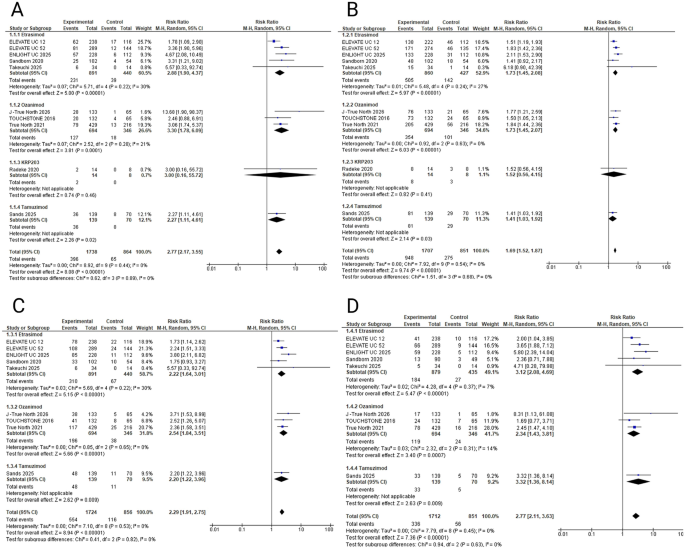
S1P receptor modulators are an emerging oral class of advanced therapy for moderate-to-severe ulcerative colitis; a systematic review that pools multiple RCTs helps clarify how effective and safe the class appears to be...