
Pakistan Journal of Pharmaceutical Sciences
Cure8 research brief
Cure8 research brief
This study raises pharmacovigilance signals and mechanistic hypotheses about liraglutide in people with ulcerative colitis — important because GLP-1 drugs are widely used and are being studied for inflammatory effects. However, the work does not prove benefit or harm; it generates questions for further research.
Clinicians treating IBD, researchers studying GLP-1 agonists or IBD drug repurposing, and patients with UC who are taking or considering GLP-1 therapies.
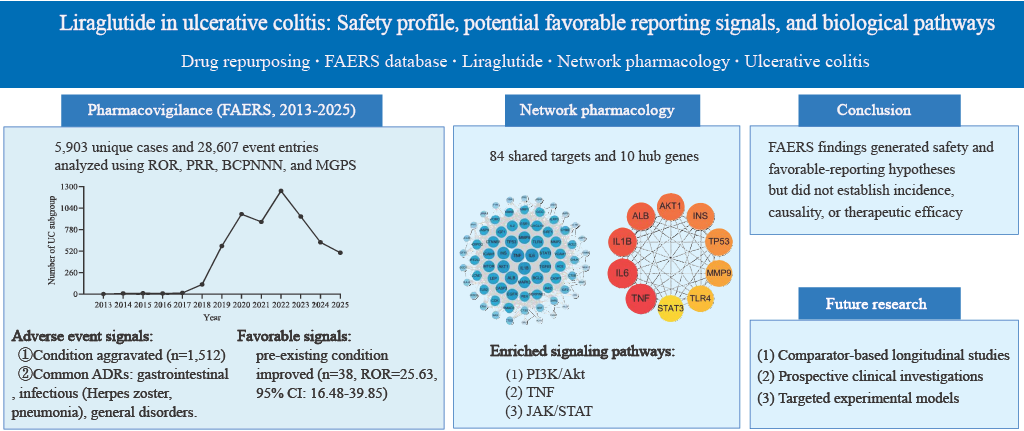
This article analyzed spontaneous adverse-event reports in FAERS where liraglutide (a GLP-1 receptor agonist) was listed as the primary suspected drug for patients with ulcerative colitis and combined that signal-detection work with network pharmacology exploring shared molecular targets and pathways.
The FAERS analysis found a mix of common event categories (including gastrointestinal and infection-related reports), some reports coded as “condition aggravated,” and a small number of reports coded as “pre-existing condition improved” that produced an exploratory disproportionality signal.
The authors emphasize these are hypothesis-generating pharmacovigilance observations and do not establish causality, incidence, or efficacy.
The network pharmacology portion identified candidate shared targets and enriched pathways (PI3K/AKT, TNF, JAK/STAT) that the authors suggest could provide biological context for the signals but require confirmation in direct comparative and experimental studies.
If you use GLP-1 drugs or follow research on repurposing them for IBD, this paper flags safety signals and possible mechanistic links worth further study but does not change clinical guidance.
This is an abstract-level report combining spontaneous-report (FAERS) disproportionality screening and in silico network pharmacology. FAERS signals can be influenced by reporting bias and cannot establish incidence or causality; the network analyses generate hypotheses that need laboratory and clinical validation.
Review the original publication for the complete reporting, methods, and context.
This Cure8 brief is based on source text from the linked article. Cure8 is informational only and is not a substitute for professional medical advice, diagnosis, or treatment.
The study suggests some autoimmune diseases common in IBD patients—ulcerative colitis and primary sclerosing cholangitis—may be genetically linked to higher pancreatitis risk. That could help researchers understand...
The study suggests that a simple, multidomain functional measure (intrinsic capacity) is linked to later IBD risk and that combining it with genetic risk may better identify people at higher risk—especially for Crohn’s...
Patients, families, and clinicians may care because the study shows pediatric-onset IBD is more often Crohn's and that children begin advanced therapies earlier than adults. The adult persistence data for vedolizumab and...


