Journal of Pediatric Gastroenterology and Nutrition
Cure8 research brief
Cure8 research brief
Imaging and endoscopy can give different pictures of disease activity in newly diagnosed pediatric Crohn’s disease. That matters because treatment decisions often rely on how active disease appears and where it’s located.
Pediatric patients with Crohn’s disease and their caregivers; pediatric gastroenterologists and imaging teams; researchers studying imaging versus endoscopic assessment in IBD.
This pediatric study compared endoscopic disease activity (SES-CD) with two cross-sectional imaging scores (IBUS‑SAS from intestinal ultrasound and PICMI from MRE) at diagnosis of Crohn’s disease.
Overall correlations between endoscopy and imaging varied by bowel location: significant correlations were observed for the terminal ileum but not for colonic disease. MRE missed superficial colonic lesions in over half of patients with colonic involvement by endoscopy.
The findings suggest that intestinal ultrasound and MRE may better reflect transmural inflammation in the terminal ileum than in the colon at diagnosis in this cohort. Clinicians and teams assessing pediatric CD should be aware that cross-sectional imaging can under-detect superficial colonic lesions compared with ileocolonoscopy.
This report is based on the article abstract from Journal of Pediatric Gastroenterology and Nutrition (structured content depth: abstract). It summarizes the authors’ retrospective cohort results and does not represent a guideline or establish clinical recommendations.
If you’re a caregiver or clinician, discuss how imaging and endoscopy findings are used together in your center to make treatment decisions rather than relying on a single test.
This is a retrospective, single‑cohort study reported in the article abstract. Results are based on correlation analyses at diagnosis and may not generalize to all centers or older patients. The summary is grounded in the article abstract and does not substitute for reading the full study.
Review the original publication for the complete reporting, methods, and context.
This Cure8 brief is based on source text from the linked article. Cure8 is informational only and is not a substitute for professional medical advice, diagnosis, or treatment.
IBD patients can have lung involvement without symptoms. Simple spirometry focused on small-airway measures might help detect early pulmonary changes and prompt further evaluation or monitoring.
This study could clarify which imaging test—MRE or IUS—is more accurate or appropriate for monitoring treatment response in Crohn's disease, potentially standardising follow-up and informing patient and clinician...
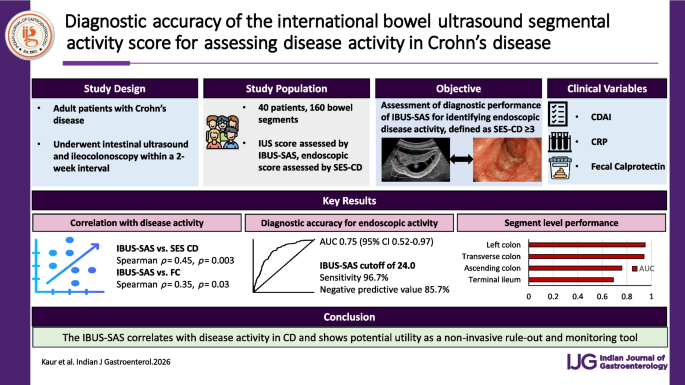
Standardized intestinal ultrasound scoring could help non-invasively monitor Crohn’s disease activity and reduce reliance on colonoscopy for some assessments. A high-sensitivity IUS score may be useful to rule out...