E-nose in Evaluating Colitis Activity
A rapid stool molecular test could offer a noninvasive way to measure inflammation, predict relapse, and monitor treatment response in children with IBD—areas where current tests have limitations.
Tests and monitoring tools
Intestinal ultrasound articles covering bowel-wall imaging, noninvasive monitoring, treatment response, and Crohn's disease or IBD research. Monitoring context emphasizes diagnosis, follow-up, disease activity, treatment response, and care decisions.
31 articles
A rapid stool molecular test could offer a noninvasive way to measure inflammation, predict relapse, and monitor treatment response in children with IBD—areas where current tests have limitations.
IBD patients can have lung involvement without symptoms. Simple spirometry focused on small-airway measures might help detect early pulmonary changes and prompt further evaluation or monitoring.
Noninvasive intestinal ultrasound with superb microvascular imaging (SMI) may help predict the presence and size of endoscopic ulcers in the terminal ileum of people with Crohn’s disease. That could improve noninvasive...
The study will test whether routine point‑of‑care intestinal ultrasound changes clinical decisions compared with standard monitoring, which could make monitoring less invasive and more responsive if effective.
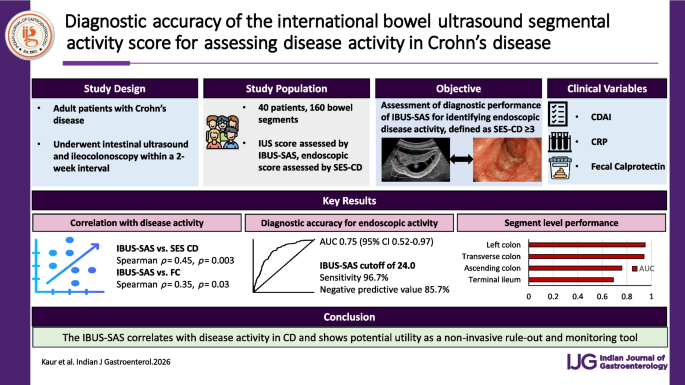
Standardized intestinal ultrasound scoring could help non-invasively monitor Crohn’s disease activity and reduce reliance on colonoscopy for some assessments. A high-sensitivity IUS score may be useful to rule out...
If intestinal ultrasound shows mild isolated hyperemia even with normal bowel wall thickness, this study found a higher chance of treatment changes, steroid use, surgery, or hospitalization within a year — information...
Intestinal ultrasound is increasingly used to evaluate Crohn’s disease because it’s noninvasive, repeatable, and can detect activity and some complications—potentially reducing reliance on more invasive tests. Wider...
The T&W criteria are still used to define severe UC on admission, but relying on them alone may delay recognition of steroid non‑response and escalation decisions. Integrating biomarkers, endoscopy, and imaging can help...
Pouchitis is a common complication after IPAA and noninvasive tools to detect inflammation could make monitoring easier and less burdensome than repeated pouchoscopy. This trial tested whether intestinal ultrasound can...
Intestinal ultrasound is a noninvasive imaging option that can help detect and monitor bowel inflammation without radiation. A new local program could improve access to this tool for people with IBD, including children.
Handheld IUS could make noninvasive bowel assessment faster and more accessible for people with IBD, helping with triage and short-term monitoring without immediately resorting to endoscopy or advanced imaging.
Measuring mucosal healing across the whole gut with stool markers, ultrasound, and capsule endoscopy may give a clearer picture of whether biologic treatment is working and help guide decisions about continuing or...
If validated, a simple ultrasound-based score could reduce the need for invasive endoscopy to monitor disease activity in children with ulcerative colitis. Noninvasive monitoring is especially valuable in pediatrics.
Automating bowel wall thickness measurement could make intestinal ultrasound more consistent and reliable for monitoring inflammation in IBD, which matters to patients and clinicians tracking disease activity.
This survey shows IUS is increasingly recognized but underutilized in China due to limited training and varied perceptions across specialties; patients generally like IUS but many have safety concerns. Addressing...
This study could clarify which imaging test—MRE or IUS—is more accurate or appropriate for monitoring treatment response in Crohn's disease, potentially standardising follow-up and informing patient and clinician...
Noninvasive ultrasound could make assessment and monitoring of ulcerative colitis quicker and more accessible, including bedside evaluation and better rectal/pouch assessment with TPUS—potentially reducing reliance on...
Noninvasive tools that reliably detect postoperative recurrence could reduce the need for frequent invasive endoscopy and help target earlier intervention for people with Crohn's disease after surgery.
Early intestinal ultrasound may predict one-year endoscopic remission in Crohn's disease, offering a noninvasive tool to guide treatment decisions and possibly reduce the need for some colonoscopies.
Detecting Crohn’s recurrence after bowel surgery is important because recurrence can occur without symptoms. A reliable non-invasive test like intestinal ultrasound could reduce the need for repeated colonoscopies and...
Noninvasive monitoring matters for children with UC because endoscopy is burdensome. If ultrasound (and simple measures like bowel wall thickness) can reliably detect moderate-to-severe disease, families may avoid some...
Point-of-care intestinal ultrasound (IUS) showed strong agreement with follow-up tests and often changed management the same day in a New Zealand IBD cohort. Patients and clinicians may be able to use IUS to monitor...
This study will collect real-world data on adults with moderate-to-severe ulcerative colitis who start upadacitinib, tracking symptom remission and imaging response over one to two years — information that can help...
Faster, accurate diagnosis can let people with Crohn's disease start appropriate treatment sooner and help avoid complications from ongoing inflammation. The article outlines common presenting symptoms and recommended...
Noninvasive tests at 3 months after ileocecal resection (ultrasound + fecal calprotectin) may identify patients at high risk of endoscopic recurrence by 6 months. That could help avoid or target postoperative endoscopy...
A reliable, accurate intestinal ultrasound could make routine monitoring easier, faster, and less costly than repeated MRI for people with Crohn’s disease. The study shows strong agreement between ultrasound scores and...
Based on the title and source metadata, this appears to be a guideline related to Crohn's disease, Inflammatory bowel disease, and Intestinal ultrasound. The original article is from springermedicine.com.
Community events like this connect people with IBD to clinical expertise and peer support. Intestinal ultrasound is a monitoring tool many patients may hear more about and could discuss with their care team.
Noninfectious (aseptic) abscesses or persistent lymphadenitis can be an early extraintestinal sign of IBD in children. Recognizing this link can prompt appropriate imaging and endoscopic evaluation that may lead to...
This study suggests using both faecal calprotectin and intestinal ultrasound together can better identify patients who reach deeper, transmural healing — and those patients had lower risk of bowel-damage progression....
This study suggests intestinal ultrasound findings early after diagnosis — especially achieving “transmural remission” within 3 months — may predict better 1-year outcomes (sustained steroid-free remission and less need...