Journal of Crohn's & colitis
Cure8 research brief
Cure8 research brief
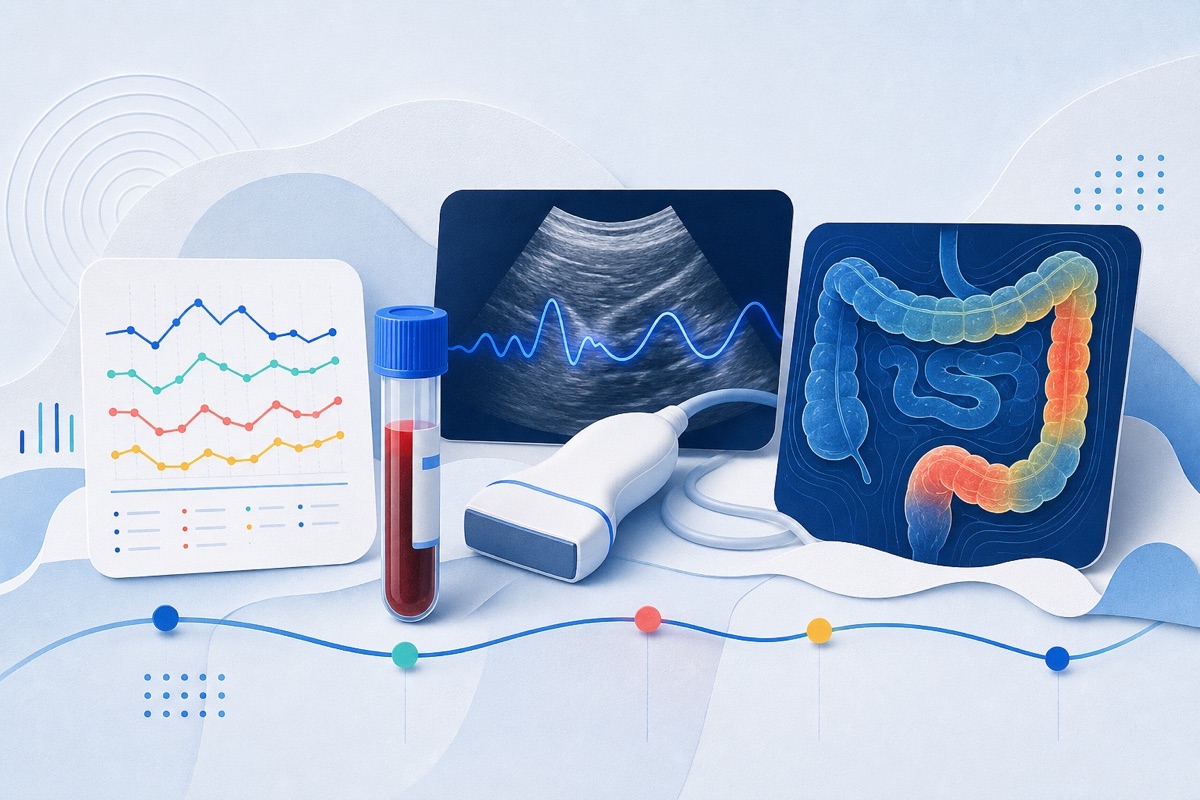
Measuring mucosal healing across the whole gut with stool markers, ultrasound, and capsule endoscopy may give a clearer picture of whether biologic treatment is working and help guide decisions about continuing or stopping therapy.
The study suggests healing can increase beyond the first year on biologics, which matters for patients and clinicians planning long‑term treatment.
Adult patients with Crohn’s disease starting biologic therapy; clinicians managing biologics; researchers studying IBD monitoring and treatment persistence; patients on anti‑TNF, vedolizumab, or ustekinumab.
This prospective cohort (MILESTONE-CD) followed adults with Crohn’s disease starting their first biologic and used fecal calprotectin (FCP), intestinal ultrasound (IUS), and pan‑enteric video capsule endoscopy (VCE) at multiple timepoints through 104 weeks.
About half (29/59) stopped biologic therapy within two years, and pan‑enteric mucosal healing rose gradually over time (from ~3% at baseline to ~32% at week 104 using non‑responder imputation). The study reports that combining FCP, IUS, and VCE can help track mucosal healing and support personalized decisions about continuing or stopping biologics.
The report is an abstract-level summary of a Journal of Crohn’s & Colitis observational study; details such as exact definitions of mucosal healing, thresholds used for FCP or imaging scores, and reasons for biologic discontinuation are summarized but not exhaustively presented here. The cohort primarily received anti‑TNF agents, vedolizumab, or ustekinumab.
This is a research study describing monitoring methods and clinical outcomes (biologic persistence and mucosal healing) rather than a treatment trial with randomized comparisons.
The findings illustrate that mucosal healing may continue to accrue after year 1 and that multimodal assessment can inform treatment decisions, but individual patient decisions should rely on clinician judgment and full clinical data.
Structured content depth is an abstract from the Journal of Crohn’s & Colitis; the available text is a partial extraction and does not include full methods or complete results. Percentages and timing reported here are from the supplied abstract and should be interpreted as study findings rather than general clinical expectations.
Review the original publication for the complete reporting, methods, and context.
Funding disclosed by the source: Sheba Medical Center
This Cure8 brief is based on source text from the linked article. Cure8 is informational only and is not a substitute for professional medical advice, diagnosis, or treatment.
Patients considering switching biologics or clinicians choosing a second‑line therapy may care because the study suggests ustekinumab had better long‑term persistence and improving remission rates compared with anti‑TNF...
Early changes in stool tests (qFIT and fecal calprotectin) might help predict which biologic‑naive ulcerative colitis patients will relapse or need escalation to biologic/JAK therapy. If validated, such markers could...
This study suggests that people with PSC-IBD may respond differently to some biologic treatments: infliximab and vedolizumab had similar early effectiveness versus IBD alone, but ustekinumab showed a lower early response...