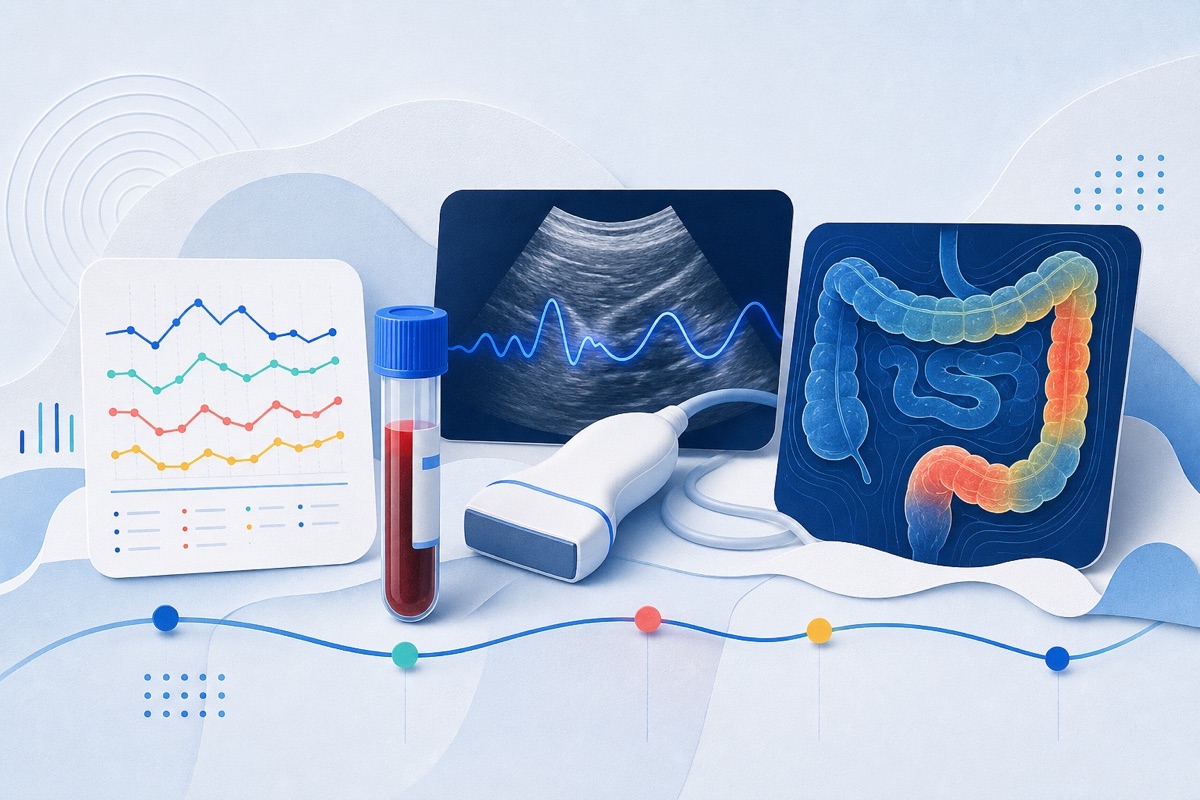
Automating bowel wall thickness measurement could make intestinal ultrasound more consistent and reliable for monitoring inflammation in IBD, which matters to patients and clinicians tracking disease activity.
Who Should Pay Attention
Clinicians who perform or interpret intestinal ultrasound, researchers working on imaging and AI for IBD, and patients interested in imaging‑based disease monitoring.
Study Snapshot
Story typeResearch paper
Evidence typeResearch paper
Source depthJournal abstract
What To Know
The authors trained U‑Net–based models on annotated IUS images and tested them against four IBUS‑certified experts. On a held‑out set the model’s measurements were close to the multi‑expert reference, and it classified BWT using a 3 mm cutoff with good specificity (0.94) and moderate sensitivity (0.69).
In a blinded test experts could not reliably tell model calipers from human calipers. The study also checked generalizability on an external dataset (C‑TRUS) and found the bowel wall was detected in 98% of images with small estimated deviation. The authors present this work as a step toward an end‑to‑end AI‑assisted IUS system for IBD monitoring.
Keep In Mind
This summary is based on the article abstract. The work is model development and validation on image datasets; it is not a report of clinical trials or real‑world deployment.
Source Details
Review the original publication for the complete reporting, methods, and context.
This Cure8 brief is based on source text from the linked article. Cure8 is informational only and is not a substitute for professional medical advice, diagnosis, or treatment.
A reliable, accurate intestinal ultrasound could make routine monitoring easier, faster, and less costly than repeated MRI for people with Crohn’s disease. The study shows strong agreement between ultrasound scores and...
Noninvasive monitoring matters for children with UC because endoscopy is burdensome. If ultrasound (and simple measures like bowel wall thickness) can reliably detect moderate-to-severe disease, families may avoid some...
Early intestinal ultrasound may predict one-year endoscopic remission in Crohn's disease, offering a noninvasive tool to guide treatment decisions and possibly reduce the need for some colonoscopies.