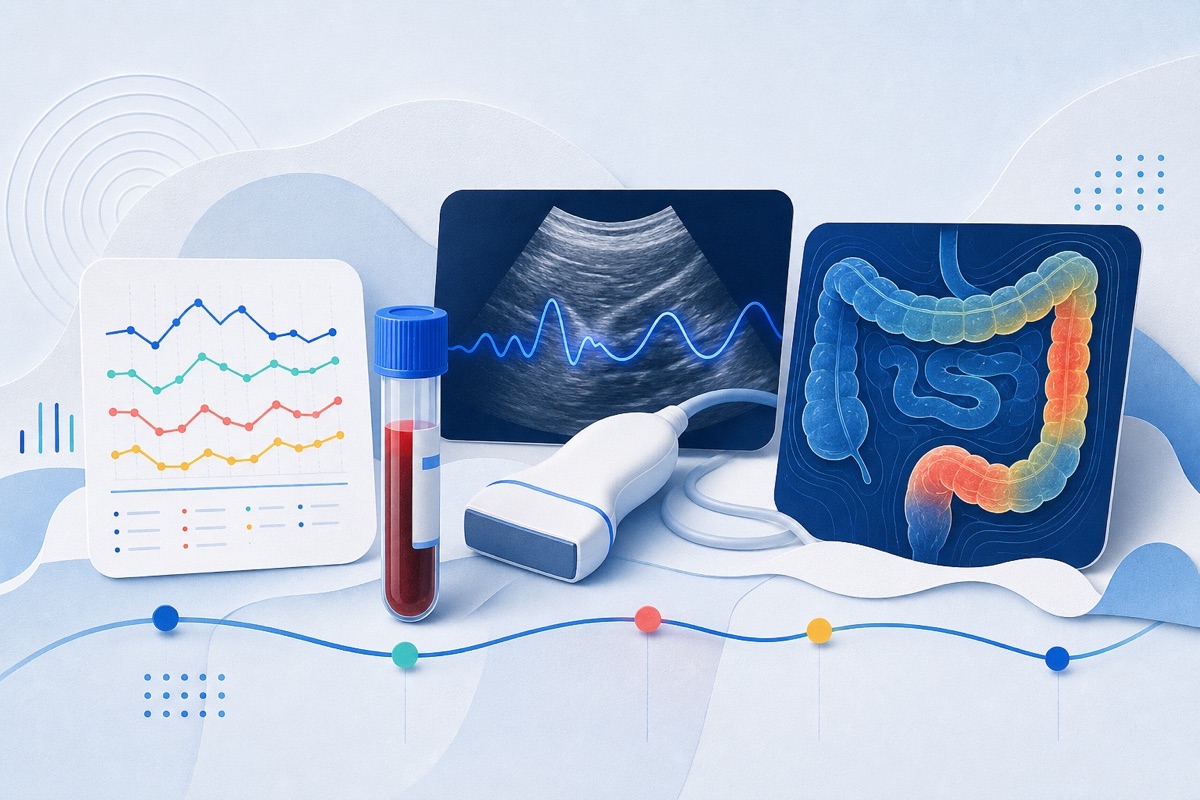
Intestinal ultrasound is increasingly used to evaluate Crohn’s disease because it’s noninvasive, repeatable, and can detect activity and some complications—potentially reducing reliance on more invasive tests. Wider adoption could improve monitoring accessibility but depends on operator skill and training.
Who Should Pay Attention
Clinicians (gastroenterologists, radiologists, sonographers), researchers studying imaging or IBD monitoring strategies, and patients interested in noninvasive monitoring options.
Study Snapshot
Story typeResearch paper
Evidence typeResearch paper
Source depthJournal abstract
What To Know
This review summarizes recent clinical and radiological interest in intestinal ultrasound (IUS) for Crohn’s disease, emphasizing IUS strengths (noninvasive, repeatable, real‑time, cost‑effective) and limitations (operator dependency, variable expertise, limited assessment of some bowel segments, lack of standardized training).
It positions IUS as part of a multimodal diagnostic strategy alongside endoscopy and cross‑sectional imaging. IUS may be particularly useful for assessing disease activity, extent, and complications at the terminal ileum and for repeat monitoring due to safety and low cost.
However, adoption depends on local expertise and training; some segments remain challenging to visualize and standardized certification pathways are lacking. If you are a clinician or service planner, the review suggests balancing IUS advantages with its training and quality-control needs before expanding clinical use.
For patients, the paper highlights IUS as a promising, less-invasive option for assessment and follow-up but notes that availability and operator skill vary.
Keep In Mind
This entry is based on the article abstract (structured content depth: abstract). The review discusses benefits and limitations of IUS but does not replace individual clinical evaluation. Availability and diagnostic performance depend on local operator experience and equipment. SummaryConfidence: medium
Source Details
Review the original publication for the complete reporting, methods, and context.
This Cure8 brief is based on source text from the linked article. Cure8 is informational only and is not a substitute for professional medical advice, diagnosis, or treatment.
Point-of-care intestinal ultrasound (IUS) showed strong agreement with follow-up tests and often changed management the same day in a New Zealand IBD cohort. Patients and clinicians may be able to use IUS to monitor...
Handheld IUS could make noninvasive bowel assessment faster and more accessible for people with IBD, helping with triage and short-term monitoring without immediately resorting to endoscopy or advanced imaging.
A reliable, accurate intestinal ultrasound could make routine monitoring easier, faster, and less costly than repeated MRI for people with Crohn’s disease. The study shows strong agreement between ultrasound scores and...