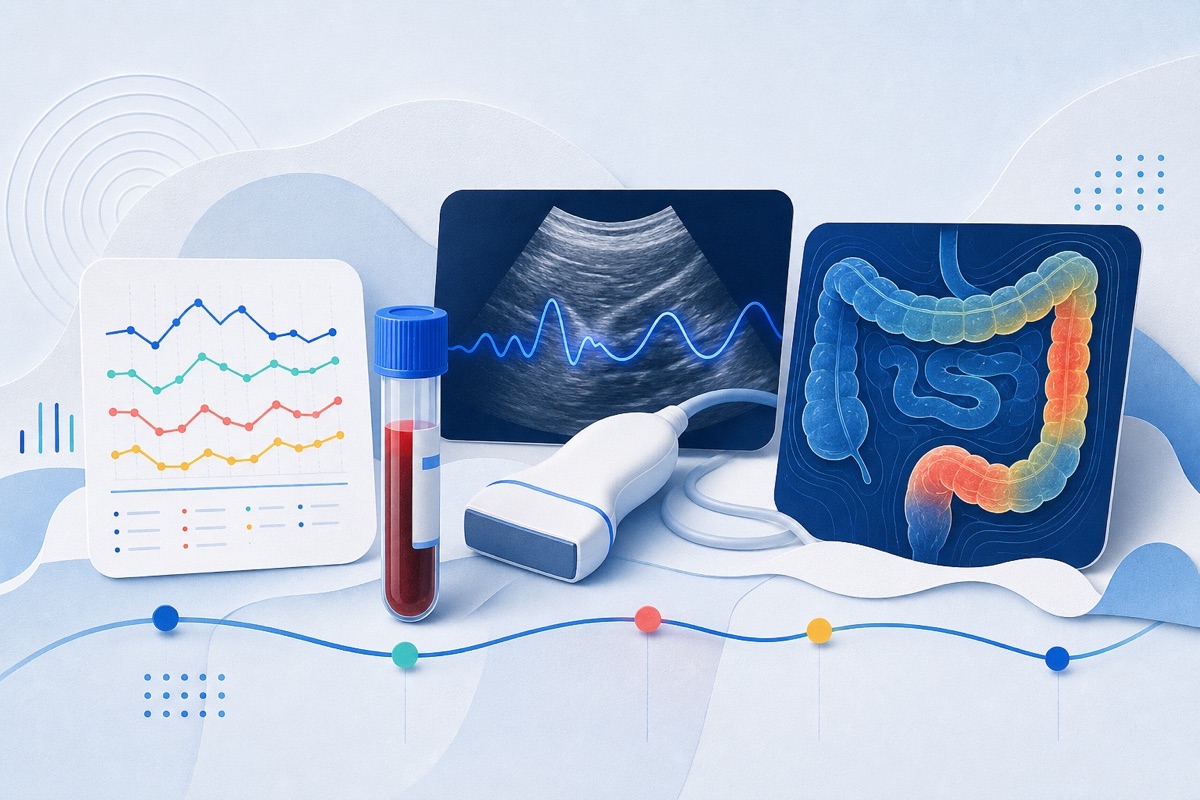
Handheld IUS could make noninvasive bowel assessment faster and more accessible for people with IBD, helping with triage and short-term monitoring without immediately resorting to endoscopy or advanced imaging.
Who Should Pay Attention
Clinicians who manage IBD (gastroenterologists, IBD nurses), researchers studying point-of-care imaging, and patients interested in less-invasive monitoring options.
Study Snapshot
Story typeResearch paper
Evidence typeResearch paper
Source depthJournal abstract
What To Know
This article is an abstract-based clinical appraisal summarizing early studies and expert assessment of HHIUS in IBD. Early evidence shows HHIUS can reliably measure bowel wall thickness and perform comparably to conventional IUS for some focused tasks, but it has limitations for deep pelvic disease and detecting complications.
Color Doppler — an important part of full IUS assessment — is not well evaluated across handheld devices, particularly for Crohn's disease. Safe use depends on training and quality oversight.
The authors emphasize that device access alone isn’t enough: structured training, supervised practice, image review, and escalation pathways (to conventional IUS, MRE/CT, or endoscopy) are needed. They also note potential roles for telementoring and AI to support use.
Overall, HHIUS may be most useful as a bedside adjunct for triage, focused monitoring, use in resource-limited settings, and education, rather than a full replacement for comprehensive IUS or cross-sectional imaging.
Keep In Mind
This classification is based on the article abstract (clinical appraisal). The appraisal highlights gaps: limited evaluation of color Doppler on handheld devices, need for interdevice reproducibility data, and requirement for structured training and escalation protocols. The source does not present new trial results but synthesizes existing early studies and expert opinion.
Source Details
Review the original publication for the complete reporting, methods, and context.
This Cure8 brief is based on source text from the linked article. Cure8 is informational only and is not a substitute for professional medical advice, diagnosis, or treatment.
Community events like this connect people with IBD to clinical expertise and peer support. Intestinal ultrasound is a monitoring tool many patients may hear more about and could discuss with their care team.
Kidney dysfunction can occur in people with IBD and may be under-recognized. A validated prediction model could help clinicians identify IBD patients at higher risk and prompt earlier monitoring or interventions.
People with IBD who have no or few symptoms but still have moderate–severe inflammation on endoscopy face uncertainty about whether to switch therapies to aim for endoscopic remission.