Research tools

CRP

CRP articles covering C-reactive protein blood testing, inflammation monitoring, treatment response, and IBD research. Research context emphasizes studies, trials, biomarkers, mechanisms, and emerging IBD science.

48 articles

Clinical trajectories after preoperative traditional Chinese medicine in biologic-refractory surgery- intended acute severe ulcerative colitis: an exploratory retrospective case series
Frontiers in Immunology

Clinical trajectories after preoperative traditional Chinese medicine in biologic-refractory surgery- intended acute severe ulcerative colitis: an exploratory retrospective case series

This paper explores whether individualized integrative management including traditional Chinese medicine might influence outcomes in patients with biologic‑refractory, surgery‑intended acute severe ulcerative colitis — a...

Read Summary
Preventing relapse in ulcerative colitis remission maintenance: machine learning prediction and reinforcement-learning herbal prescription optimization with external validation
Frontiers in Medicine

Preventing relapse in ulcerative colitis remission maintenance: machine learning prediction and reinforcement-learning herbal prescription optimization with external validation

The work aims to predict relapse and personalize herbal maintenance dosing for UC, which matters because better risk stratification and tailored management could reduce relapses and avoid unnecessary treatment changes.

Read Summary
Serum leucine-rich α-2-glycoprotein and monocyte chemoattractant protein-1 as novel biomarkers for predicting vedolizumab response in patients with ulcerative colitis.
Crohn's & colitis 360

Serum leucine-rich α-2-glycoprotein and monocyte chemoattractant protein-1 as novel biomarkers for predicting vedolizumab response in patients with ulcerative colitis.

Blood biomarkers that predict vedolizumab response could help patients and clinicians choose the most effective therapy sooner and avoid ineffective treatments. The study suggests LRG and MCP‑1 may differentiate...

Read Summary
Clinical and endoscopic features of checkpoint inhibitor-induced colitis and their association with selective immunosuppressive therapy use.
Inflammatory bowel diseases

Clinical and endoscopic features of checkpoint inhibitor-induced colitis and their association with selective immunosuppressive therapy use.

People receiving immune checkpoint inhibitors who develop colitis may face different risks of needing stronger immunosuppression depending on the ICI drug class. Understanding which features predict escalation could...

Read Summary
Outcomes of risankizumab use in adults with Crohn's disease in a real-world setting (ARISE-CD): a multicentre, retrospective cohort study.
BMJ open gastroenterology

Outcomes of risankizumab use in adults with Crohn's disease in a real-world setting (ARISE-CD): a multicentre, retrospective cohort study.

This real-world multicentre study evaluates risankizumab effectiveness and short-term persistence in adults with Crohn's disease, including those previously treated with ustekinumab — information that can help patients...

Read Summary
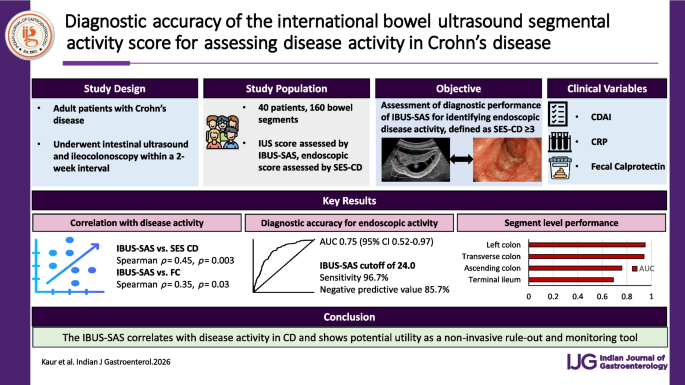
Diagnostic accuracy of the international bowel ultrasound segmental activity score for assessing disease activity in Crohn’s disease
Indian Journal of Gastroenterology

Diagnostic accuracy of the international bowel ultrasound segmental activity score for assessing disease activity in Crohn’s disease

Standardized intestinal ultrasound scoring could help non-invasively monitor Crohn’s disease activity and reduce reliance on colonoscopy for some assessments. A high-sensitivity IUS score may be useful to rule out...

Read Summary
Hormonal contraception is not associated with recurrent flares in ulcerative colitis: a longitudinal time-dependent analysis
Inflammatory Bowel Diseases

Hormonal contraception is not associated with recurrent flares in ulcerative colitis: a longitudinal time-dependent analysis

Many women with UC use hormonal contraception and worry it might worsen disease activity. This study provides evidence that HCT was not linked to more recurrent flares or higher cumulative inflammatory burden in the...

Read Summary
C-Reactive Protein-to-Albumin Ratio in Pediatric Inflammatory Bowel Disease: Associations with Disease Activity and Comparison with C-Reactive Protein Alone
Diagnostics

C-Reactive Protein-to-Albumin Ratio in Pediatric Inflammatory Bowel Disease: Associations with Disease Activity and Comparison with C-Reactive Protein Alone

This paper evaluates CAR, a simple blood‑based biomarker, in children with IBD and finds it reflects disease severity and changes over time in pediatric Crohn’s disease. That matters because reliable, easy-to-measure...

Read Summary
Fatigue in inflammatory bowel disease beyond intestinal inflammation: A cross-sectional study.
Journal of psychosomatic research

Fatigue in inflammatory bowel disease beyond intestinal inflammation: A cross-sectional study.

Fatigue is common and disabling for people with IBD; this study shows that factors beyond intestinal inflammation—especially central sensitization and psychological symptoms—explain much of fatigue. That means treating...

Read Summary
Inflammatory burden index (CRP×NLR) is associated with moderate-to-severe endoscopic activity in hospitalized patients with ulcerative colitis: a single-center retrospective study.
Crohn's & colitis 360

Inflammatory burden index (CRP×NLR) is associated with moderate-to-severe endoscopic activity in hospitalized patients with ulcerative colitis: a single-center retrospective study.

The study tests whether a simple blood-derived index (CRP×NLR) can help identify moderate-to-severe endoscopic inflammation when timely endoscopy is limited in hospitalized UC patients.

Read Summary
Beyond Clinical Toxicity: Repositioning the Truelove and Witts Criteria in the Treat-to-Target Era of Acute Severe Ulcerative Colitis
Gastroenterology Insights

Beyond Clinical Toxicity: Repositioning the Truelove and Witts Criteria in the Treat-to-Target Era of Acute Severe Ulcerative Colitis

The T&W criteria are still used to define severe UC on admission, but relying on them alone may delay recognition of steroid non‑response and escalation decisions. Integrating biomarkers, endoscopy, and imaging can help...

Read Summary
Circulating microRNAs as biomarkers of disease activity and treatment response in Crohn’s disease patients receiving infliximab or vedolizumab: a longitudinal cohort study
Frontiers in Medicine

Circulating microRNAs as biomarkers of disease activity and treatment response in Crohn’s disease patients receiving infliximab or vedolizumab: a longitudinal cohort study

If validated, blood microRNAs could become noninvasive biomarkers to help track inflammation and predict biochemical response to infliximab or vedolizumab in Crohn’s disease, complementing CRP and fecal calprotectin.

Read Summary

Performance of the 2025 ASAS-Spartan Revised Classification Criteria for Axial Spondyloarthritis in a Canadian Multicenter Inception Cohort with Psoriasis, Uveitis, or Colitis Presenting with Undiagnosed Back Pain

The criteria were tested specifically in patients with psoriasis, uveitis, or IBD presenting with chronic back pain—groups at higher risk of axSpA—so results inform how well the new criteria perform in these real‑world...

Read Summary
Prospective real-world experience with risankizumab in difficult-to-treat Crohn’s disease: results from the Dutch Initiative on Crohn and Colitis Registry
PubMed Central

Prospective real-world experience with risankizumab in difficult-to-treat Crohn’s disease: results from the Dutch Initiative on Crohn and Colitis Registry

The study provides real-world effectiveness and safety data for risankizumab in a largely difficult-to-treat Crohn's population, showing about half achieved corticosteroid-free clinical remission at 24 weeks —...

Read Summary
STUDY OF THE ADDED VALUE OF A TRANSMURAL EVALUATION IN PATIENTS WITH CROHN'S DISEASE UNDER BIOTHERAPY WITH CLOSE FECAL CALPROTECTIN FOLLOW-UP
ClinicalTrials.gov

STUDY OF THE ADDED VALUE OF A TRANSMURAL EVALUATION IN PATIENTS WITH CROHN'S DISEASE UNDER BIOTHERAPY WITH CLOSE FECAL CALPROTECTIN FOLLOW-UP

The study tests whether adding MRI-based transmural assessment to a fecal-calprotectin–guided (CALM) strategy improves the ability to keep people with Crohn’s disease in corticosteroid-free clinical remission and may...

Read Summary
Blood heavy metal and trace element levels in newly diagnosed cases of inflammatory bowel disease.
Pakistan journal of medical sciences

Blood heavy metal and trace element levels in newly diagnosed cases of inflammatory bowel disease.

The study suggests nickel accumulation and iron deficiency may be linked with more severe IBD. If confirmed, blood metal and micronutrient levels could help researchers understand disease mechanisms and guide nutritional...

Read Summary
New Diagnostic Criteria for Acute Severe Ulcerative Colitis in the Modern Treatment Era: A Modified Delphi Consensus by REFINED-ASUC.
Clinical gastroenterology and hepatology : the official clinical practice journal of the American Gastroenterological Association

New Diagnostic Criteria for Acute Severe Ulcerative Colitis in the Modern Treatment Era: A Modified Delphi Consensus by REFINED-ASUC.

The 1955 Truelove and Witts criteria do not account for patients already on modern outpatient therapies. Updated consensus criteria could change how ASUC is recognized and triaged in current clinical practice.

Read Summary
Upadacitinib as a rescue therapy for steroid- and infliximab-refractory acute severe ulcerative colitis: short- and long-term effectiveness and safety in a multicenter cohort study
Inflammatory Bowel Diseases

Upadacitinib as a rescue therapy for steroid- and infliximab-refractory acute severe ulcerative colitis: short- and long-term effectiveness and safety in a multicenter cohort study

For patients and clinicians facing steroid- and infliximab-refractory acute severe ulcerative colitis, upadacitinib may be a third-line medical option that can produce rapid symptom and CRP improvement and allow some...

Read Summary
Effects of exercise therapy on quality of life in patients with inflammatory bowel disease: a network meta-analysis
Frontiers in Physiology

Effects of exercise therapy on quality of life in patients with inflammatory bowel disease: a network meta-analysis

Exercise is a low-cost, accessible intervention that may improve quality of life and reduce symptoms in people with IBD. This pooled analysis suggests some exercise types — especially regular continuous aerobic exercise...

Read Summary
Association of serological markers with endoscopic mucosal healing and disease activity in patients with inflammatory bowel disease: a retrospective study
Frontiers in Immunology

Association of serological markers with endoscopic mucosal healing and disease activity in patients with inflammatory bowel disease: a retrospective study

Blood markers that correlate with endoscopic healing could help track inflammation noninvasively and may reduce the frequency of endoscopy if validated. For people with IBD, better blood-based tools could make monitoring...

Read Summary
Lowering the C‐Reactive Protein ( CRP ) Threshold Improves Risk Stratification in Acute Ulcerative Colitis: A Propensity‐Matched Analysis
Alimentary Pharmacology & Therapeutics

Lowering the C‐Reactive Protein ( CRP ) Threshold Improves Risk Stratification in Acute Ulcerative Colitis: A Propensity‐Matched Analysis

Lowering the CRP cutoff could help hospitals identify hospitalized UC patients at higher risk of needing surgery who are currently classified as less severe. That may affect monitoring and treatment decisions during...

Read Summary
Proactive therapeutic drug monitoring of infliximab leads to treatment durability in paediatric Crohn's disease: A single‐centre Australian experience
JPGN Reports

Proactive therapeutic drug monitoring of infliximab leads to treatment durability in paediatric Crohn's disease: A single‐centre Australian experience

Proactive TDM of infliximab was associated with high 1‑ and 2‑year durability in this pediatric Crohn's cohort, and the study flags clinical factors that may predict need to switch biologics. This could be relevant when...

Read Summary
Inflammatory marker profiles vary by BMI across Crohn’s disease, ulcerative colitis, psoriasis, and psoriatic arthritis
Frontiers in Endocrinology

Inflammatory marker profiles vary by BMI across Crohn’s disease, ulcerative colitis, psoriasis, and psoriatic arthritis

Markers of systemic inflammation (CRP and ESR) were consistently higher in people with obesity across Crohn’s disease, ulcerative colitis, psoriasis, and psoriatic arthritis, suggesting body weight may influence...

Read Summary
Vedolizumab in biologic-naïve ulcerative colitis: a multicenter real-world evaluation of clinical benefits and exploratory inflammatory indices
Frontiers in Medicine

Vedolizumab in biologic-naïve ulcerative colitis: a multicenter real-world evaluation of clinical benefits and exploratory inflammatory indices

Patients and clinicians choosing first‑line biologic therapy for ulcerative colitis may find evidence here that vedolizumab can provide sustained clinical benefit and a favorable safety profile in a biologic‑naïve...

Read Summary
Bowel Urgency in Ulcerative Colitis Is Associated With Clinical Endpoints, Health-Related Quality of Life, and Biomarkers: Data From the Etrasimod ELEVATE UC 52 Trial
Crohn's & Colitis 360

Bowel Urgency in Ulcerative Colitis Is Associated With Clinical Endpoints, Health-Related Quality of Life, and Biomarkers: Data From the Etrasimod ELEVATE UC 52 Trial

Bowel urgency is a common, disruptive UC symptom; this trial analysis shows urgency improvements with etrasimod track with clinical remission, endoscopic improvement, better quality of life, and lower inflammatory...

Read Summary
Current and novel biomarkers for predicting and assessing therapeutic response in inflammatory bowel disease: a systematic review.
Therapeutic advances in gastroenterology

Current and novel biomarkers for predicting and assessing therapeutic response in inflammatory bowel disease: a systematic review.

People with IBD and their clinicians want ways to predict which advanced therapy will work best. This review summarizes current evidence and shows that, despite many studies, no biomarker is reliably ready for routine...

Read Summary
Evaluation of serum human galectin 3 as a marker of activity in inflammatory bowel disease in comparison to fecal calprotectin.
The Egyptian journal of immunology

Evaluation of serum human galectin 3 as a marker of activity in inflammatory bowel disease in comparison to fecal calprotectin.

Noninvasive blood biomarkers that track IBD activity could reduce reliance on repeat endoscopy. If validated, serum galectin‑3 might complement fecal calprotectin and CRP to help identify active disease.

Read Summary
Machine Learning-Based Prediction of Treatment Response to Vitamin D3 in Adolescents and Young Adults with Inflammatory Bowel Disease: A Prospective, Open-Label, Alternation-Based Comparative Study
Biomedicines

Machine Learning-Based Prediction of Treatment Response to Vitamin D3 in Adolescents and Young Adults with Inflammatory Bowel Disease: A Prospective, Open-Label, Alternation-Based Comparative Study

Vitamin D supplementation is commonly considered in people with IBD because deficiency is frequent and low vitamin D may relate to inflammation.

Read Summary
Effectiveness and Safety of Mirikizumab in Patients With Moderate-to-severe Ulcerative Colitis: a Real-life Retrospective Multicenter Study
ClinicalTrials.gov

Effectiveness and Safety of Mirikizumab in Patients With Moderate-to-severe Ulcerative Colitis: a Real-life Retrospective Multicenter Study

This study reports real-world data on mirikizumab in adults with ulcerative colitis, focusing on clinical and endoscopic remission and inflammatory markers — outcomes patients and clinicians use to judge treatment...

Read Summary
A Longitudinal Disease Progression Model Characterizing Endoscopic Response and Remission in Crohn's Disease.
Journal of pharmacokinetics and pharmacodynamics

A Longitudinal Disease Progression Model Characterizing Endoscopic Response and Remission in Crohn's Disease.

Understanding and quantifying placebo-driven endoscopic changes can improve design and interpretation of Crohn’s disease trials, which may ultimately speed development of effective therapies and clarify who benefits from...

Read Summary
Ventyx Biosciences Announces Presentation of Data from the Phase 2 Trial of Allosteric TYK2 Inhibitor VTX958 in Crohn’s Disease at ECCO 2025
markets.businessinsider.com

Ventyx Biosciences Announces Presentation of Data from the Phase 2 Trial of Allosteric TYK2 Inhibitor VTX958 in Crohn’s Disease at ECCO 2025

This reports Phase 2 clinical data for an oral TYK2 inhibitor (VTX958) in Crohn’s disease — a potential new oral treatment approach. The drug showed meaningful endoscopic improvements and reductions in inflammatory...

Read Summary