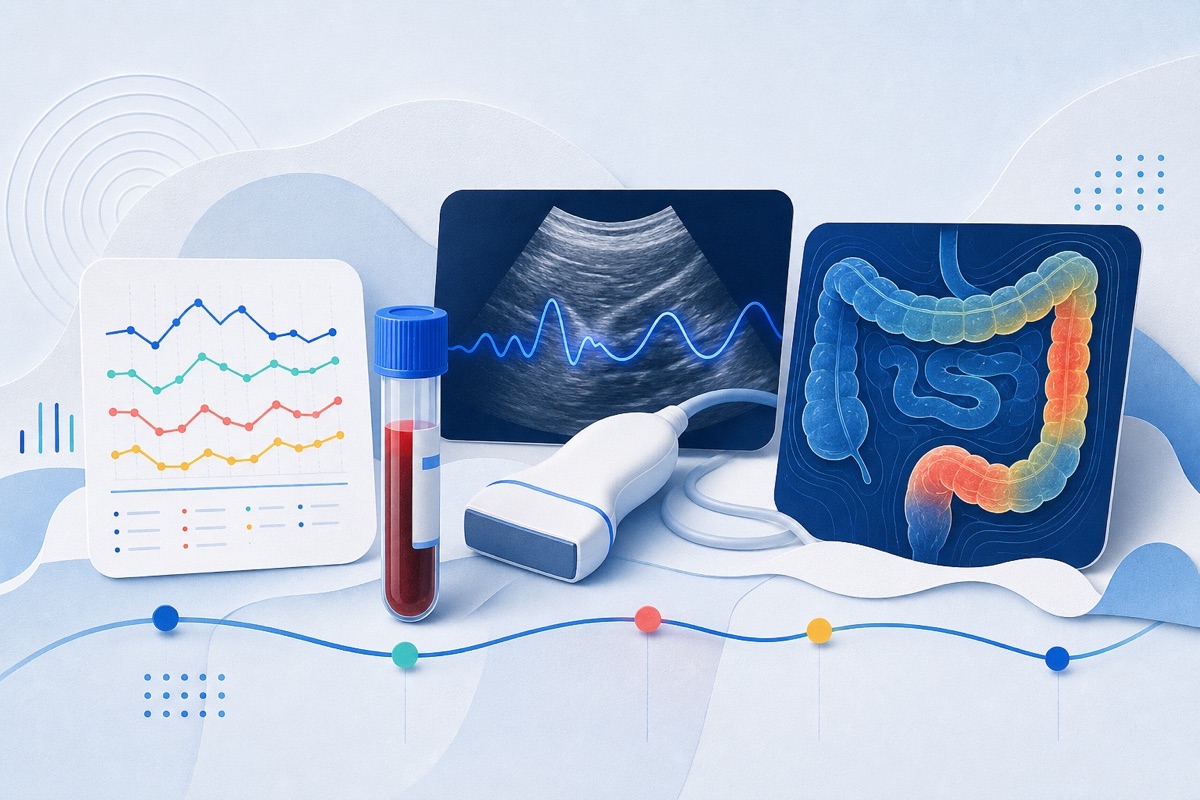
Noninvasive tools that reliably detect postoperative recurrence could reduce the need for frequent invasive endoscopy and help target earlier intervention for people with Crohn's disease after surgery.
Who Should Pay Attention
Adult Crohn's disease patients after intestinal surgery, clinicians who manage postoperative surveillance (gastroenterologists, IBD nurses), and centers offering intestinal ultrasound
Study Snapshot
Story typeResearch paper
Evidence typeResearch paper
Source depthJournal abstract
What To Know
The article summarizes studies and meta-analyses showing good diagnostic performance for IUS (pooled sensitivity and specificity reported in the review). Higher bowel wall thickness thresholds (example: ≥5.5 mm) are linked with more severe recurrence. IUS may be useful to triage patients for closer surveillance, earlier ileocolonoscopy, or further imaging.
The review also highlights limitations: no postoperative-specific IUS score has been validated, thresholds and interpretation vary with surgical anatomy and operator skill, and very early postoperative IUS can be confounded by healing or remodeling changes.
Practical takeaway: IUS shows promise as part of a multimodal, risk-adapted postoperative monitoring strategy, but it is not yet a standalone replacement for ileocolonoscopy and requires local expertise and standardized protocols for postoperative use.
Keep In Mind
This record is a review/abstract summarizing recent studies and meta-analyses rather than a single new trial. The authors note limitations including lack of validated postoperative-specific IUS scoring and variability by operator and surgical anatomy. Very early postoperative scans may be hard to interpret.
Source Details
Review the original publication for the complete reporting, methods, and context.
This Cure8 brief is based on source text from the linked article. Cure8 is informational only and is not a substitute for professional medical advice, diagnosis, or treatment.
Point-of-care intestinal ultrasound (IUS) showed strong agreement with follow-up tests and often changed management the same day in a New Zealand IBD cohort. Patients and clinicians may be able to use IUS to monitor...
This study suggests using both faecal calprotectin and intestinal ultrasound together can better identify patients who reach deeper, transmural healing — and those patients had lower risk of bowel-damage progression....
Noninvasive tests at 3 months after ileocecal resection (ultrasound + fecal calprotectin) may identify patients at high risk of endoscopic recurrence by 6 months. That could help avoid or target postoperative endoscopy...