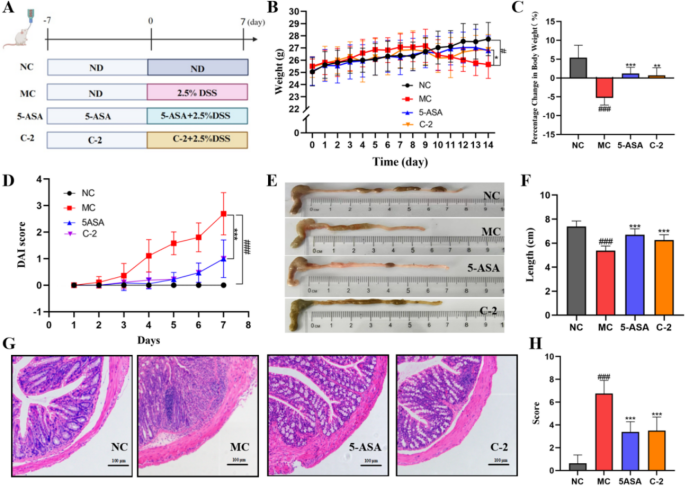
If probiotic strains can increase beneficial microbial metabolites that strengthen the gut barrier and reduce inflammation, they could point to new adjunctive strategies for IBD treatment.
This study highlights tryptophan-derived indoles and AhR signaling as a possible mechanism linking microbiota changes to reduced colitis in mice.
Who Should Pay Attention
Researchers studying the microbiome, metabolite-mediated immune regulation, and AhR signaling; clinicians and patients interested in probiotic approaches or microbiome-targeted adjuncts for ulcerative colitis; translational scientists planning preclinical-to-clinical studies.
Study Snapshot
Story typeResearch paper
Evidence typeResearch paper
Source depthMetadata only
What To Know
The paper describes experiments in mice (DSS-induced UC) showing improvements in weight loss, disease activity index, colon length, histologic inflammation, intestinal barrier proteins (Claudin-1, Occludin, ZO-1, MUC2), and lower pro-inflammatory cytokines after treatment with the C-2 strain.
The authors link these effects to changes in the gut microbiome (higher diversity, enrichment of Bifidobacterium and Prevotellaceae), restored SCFA levels, and altered tryptophan metabolism with increased indole metabolites (IPA, I3A) and activation of the aryl hydrocarbon receptor (AhR)/Cyp1a1 signaling pathway.
This is preclinical research in mice and the article is behind a subscription paywall for full access; the summary here is based on the article abstract and extracted text provided.
Keep In Mind
This study was performed in a DSS mouse model of ulcerative colitis, which is a common preclinical model but does not prove efficacy or safety in humans. The article is published in an academic journal and full details are behind a subscription. Results should be interpreted as preliminary and hypothesis-generating.
Source Details
Review the original publication for the complete reporting, methods, and context.
Funding disclosed by the source: the Science Research Project of Hebei Education Department, award BJ2025117; Tianjin Science and Technology Plan Project, award 25ZYCGSN00650; Beijing-Tianjin-Hebei Natural Science Foundation Cooperation Project, award 25JJJJC0039; National Natural Science Foundation of China, award 31801514
This Cure8 brief is based on source text from the linked article. Cure8 is informational only and is not a substitute for professional medical advice, diagnosis, or treatment.
People with ulcerative colitis may be interested because the study suggests a combined probiotic approach could strengthen gut bacteria functions linked to a protective metabolite (spermidine) and reduce colitis-like...
Preclinical work identified a plant-root extract fraction that reduced inflammation and improved some gut-barrier and microbiome features in a mouse model of ulcerative colitis, which could guide future research into new...
This study suggests a specific four-strain probiotic cocktail may better protect against experimental colitis than the three-strain mix, potentially via microbiota-driven increases in spermidine — a microbial metabolite...