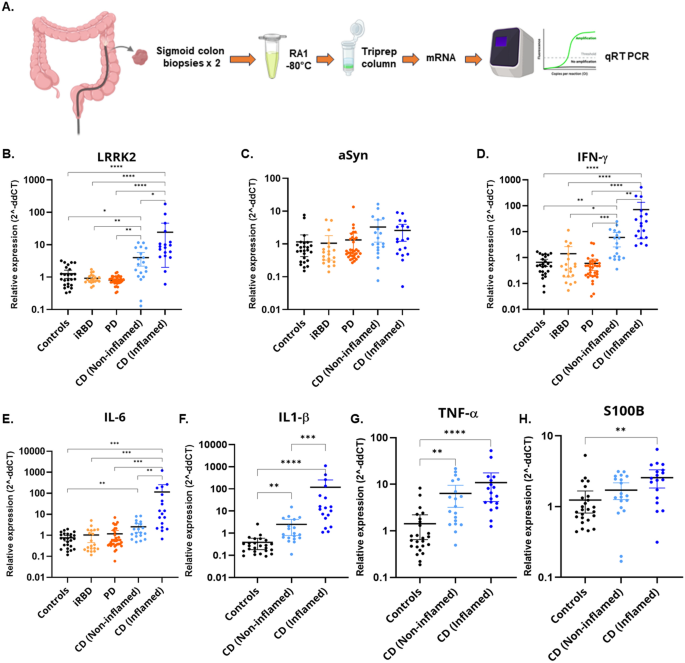
Findings about increased LRRK2 in colonic tissue may point to shared immune or genetic mechanisms between Crohn’s disease and neurological disorders, which could be relevant for future research and biomarker development.
Who Should Pay Attention
Researchers studying IBD–neurodegeneration links, clinicians interested in IBD pathophysiology, and people with Crohn’s disease following research on disease mechanisms and biomarkers.
Study Snapshot
Story typeResearch paper
Evidence typeClinical study
Source depthFull source text
What To Know
This correspondence describes tissue-level findings (colonic LRRK2 expression) from human samples. The report focuses on molecular expression patterns rather than a new treatment, so it does not change clinical care but may inform research into shared mechanisms between Crohn’s disease and Parkinson-related disorders.
The article is published in a peer-reviewed neuropathology journal and appears to be a short correspondence or research note; methods and sample details will determine how generalizable the result is. If you want implications for testing or treatment, discuss with your clinician—this is early mechanistic research rather than a clinical guideline.
Keep In Mind
This is a correspondence/tissue-expression report in Acta Neuropathologica; it reports molecular expression differences but does not report clinical outcomes or recommend changes in patient care.
Source Details
Review the original publication for the complete reporting, methods, and context.
Clinical studyArticle type assigned from Cure8 classification; confirm details in the original source.
Publicationlink.springer.com
Indexed viaGoogle News
Source typeWeb article
PublishedSep 19, 2026, 11:41 PM
Content availableFull source text
This Cure8 brief is based on source text from the linked article. Cure8 is informational only and is not a substitute for professional medical advice, diagnosis, or treatment.
The work identifies a genetic link (HLA‑DRB1*01:03) to anti‑IL‑10 autoantibodies and describes a small subgroup of IBD patients who may have a distinct immune mechanism driving disease—information that could matter for...
The study suggests a possible link between psoriasis, leaky gut, and Crohn’s disease—topics that could help explain why some people with psoriasis report more gut problems. People with psoriasis or IBD may find the...
Researchers found distinct microbial and host molecular features in the appendices of children with IBD, which could help explain local immune activation and guide future studies of disease mechanisms or biomarkers.