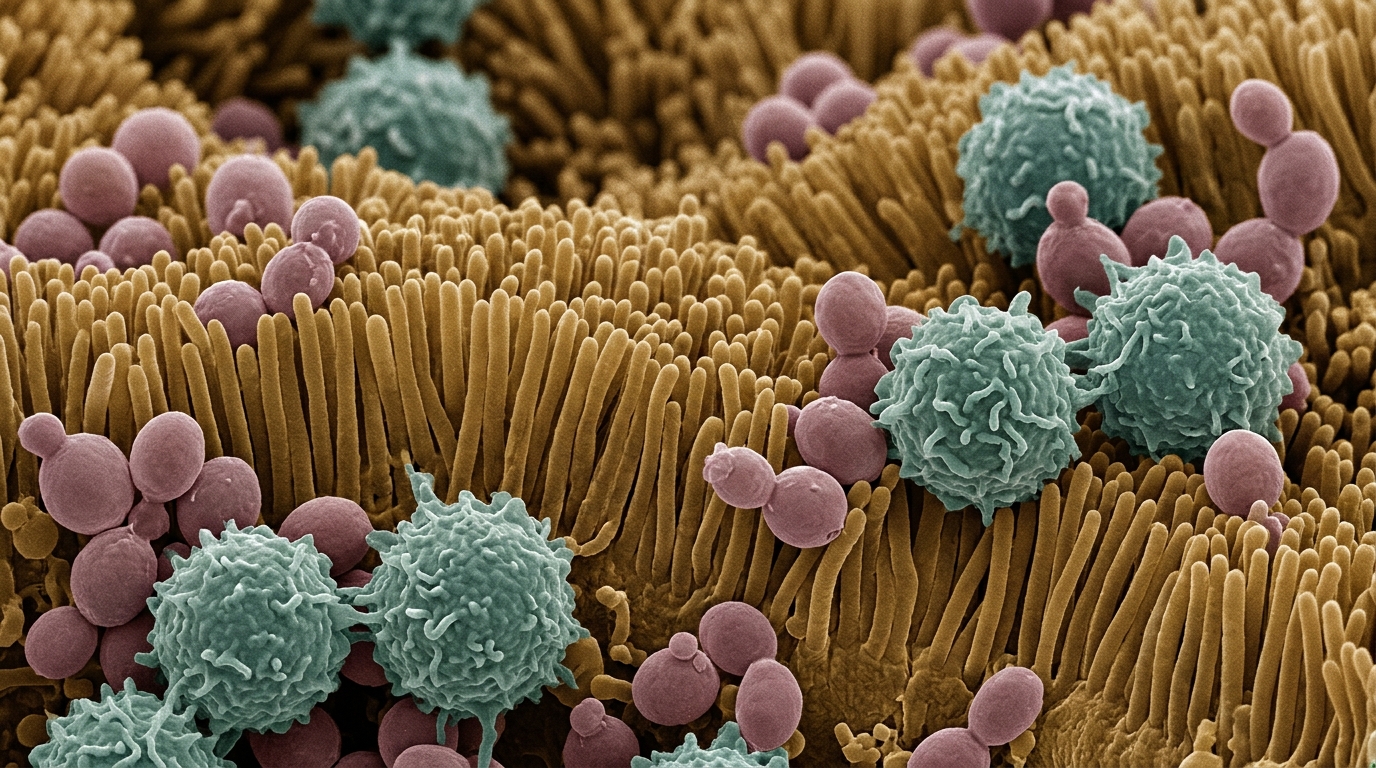
This work links a specific immune pathway (bacterial metabolite sensing by Vδ2+ T‑cells leading to IL‑22 production) to suppression of intestinal Candida, and shows that the pathway is impaired in Crohn’s disease — which may help explain fungal overgrowth and contribute to inflammatory features in affected tissue.
Who Should Pay Attention
Researchers studying gut immunity, microbiome–fungus interactions, and IBD pathogenesis; clinicians interested in infectious or microbial contributors to Crohn’s disease; patients and caregivers curious about immune–microbe interactions in IBD.
Study Snapshot
Story typeResearch paper
Evidence typeClinical study
Source depthFull source text
What To Know
A PLOS Biology study summarized here reports that in healthy human intestinal tissue a specialized Vγ9Vδ2+ (Vδ2+) T-cell population is activated by the bacterial metabolite HMB-PP and, via an IL-22–dependent mechanism, suppresses growth of the fungus Candida albicans.
The authors used human intestinal organ cultures, genomic/proteomic analysis of fungal isolates, ex vivo immune assays, and an intestine-on-a-chip model to study interactions between these T‑cells, bacteria-derived HMB‑PP, and Candida.
In intestinal tissue from people with Crohn’s disease, the Vδ2+ T-cells were less responsive to HMB‑PP, permitting outgrowth of Crohn’s-derived C. albicans strains that showed increased adhesion, filament/toxin production, triggered neutrophil extracellular traps, induced macrophage IL‑1β release, and invaded a gut-barrier model more rapidly.
These findings point to a specific host–microbe–fungus pathway (HMB‑PP → Vδ2+ T‑cell activation → IL‑22) that restrains fungal pathobionts in healthy tissue and is disrupted in Crohn’s disease. The study draws on experimental models and analyses reported in a peer-reviewed article in PLOS Biology (Mathew et al., 2026).
If you want the original data and detailed methods, consult the PLOS Biology paper referenced in the article.
Keep In Mind
The article summarizes experimental and ex vivo work reported in a PLOS Biology paper; these are model and laboratory findings that suggest mechanisms rather than clinical treatments. Further research is needed to determine clinical relevance, causality in patients, and therapeutic implications.
Source Details
Review the original publication for the complete reporting, methods, and context.
This Cure8 brief is based on source text from the linked article. Cure8 is informational only and is not a substitute for professional medical advice, diagnosis, or treatment.
Researchers found distinct microbial and host molecular features in the appendices of children with IBD, which could help explain local immune activation and guide future studies of disease mechanisms or biomarkers.
The work identifies a genetic link (HLA‑DRB1*01:03) to anti‑IL‑10 autoantibodies and describes a small subgroup of IBD patients who may have a distinct immune mechanism driving disease—information that could matter for...
This study suggests viral exposures—specifically Epstein–Barr virus—might be associated with later development of Crohn’s disease, which could help researchers study disease triggers. If confirmed, such findings might...