Frontiers in Bioengineering and Biotechnology
Cure8 research brief
Cure8 research brief
New targeted delivery approaches aim to concentrate therapy in the gut lining and inflamed areas, which could improve effectiveness and reduce systemic side effects for people with IBD.
Researchers; clinicians in gastroenterology and translational medicine; those interested in IBD-targeted therapies
The article summarizes biological barriers across GI segments (oral cavity through colon) that limit drug stability, penetration, retention, and controlled release.
It reviews delivery technologies — liposomes, polymeric nanoparticles, dendrimers, inorganic nanoparticles, hydrogels, microspheres, microneedles, and microrobots — and categorizes targeting strategies as passive, active (ligand-mediated), and stimuli-responsive (pH, enzymes, redox).
It highlights translational challenges and opportunities for treating inflammatory bowel disease and other GI conditions, focusing on designing biocompatible systems that achieve mucosal penetration and localized release. The piece is presented as a roadmap for moving bench advances toward clinically viable gut-targeted therapies.
This is a review article (abstract-level content provided). It synthesizes preclinical and translational research rather than reporting results from a single clinical trial; technologies reviewed will be at different development stages.
Review the original publication for the complete reporting, methods, and context.
This Cure8 brief is based on source text from the linked article. Cure8 is informational only and is not a substitute for professional medical advice, diagnosis, or treatment.
The study describes a new oral-delivery microsphere that improved loading and gut-targeted release of celastrol and showed beneficial effects in a mouse colitis model and on gut microbiota. If translatable, this approach...
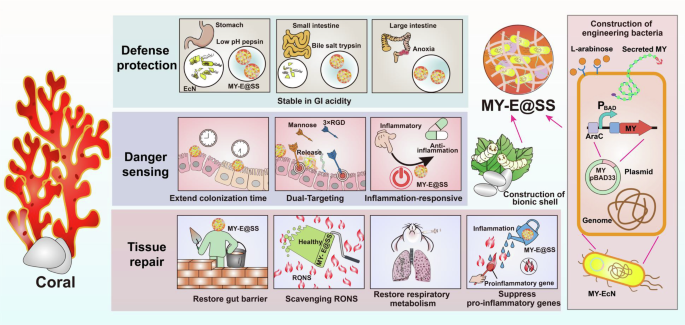
This study presents an engineered probiotic delivery platform that could improve survival and targeted action of live microbial therapies for IBD, potentially reducing local inflammation while affecting the gut...
The paper proposes a specific molecular link between elevated glycocholic acid (a bile acid altered in IBD) and impaired intestinal stem cell renewal via the TRIB3–ID1 pathway, which could help explain poor mucosal...