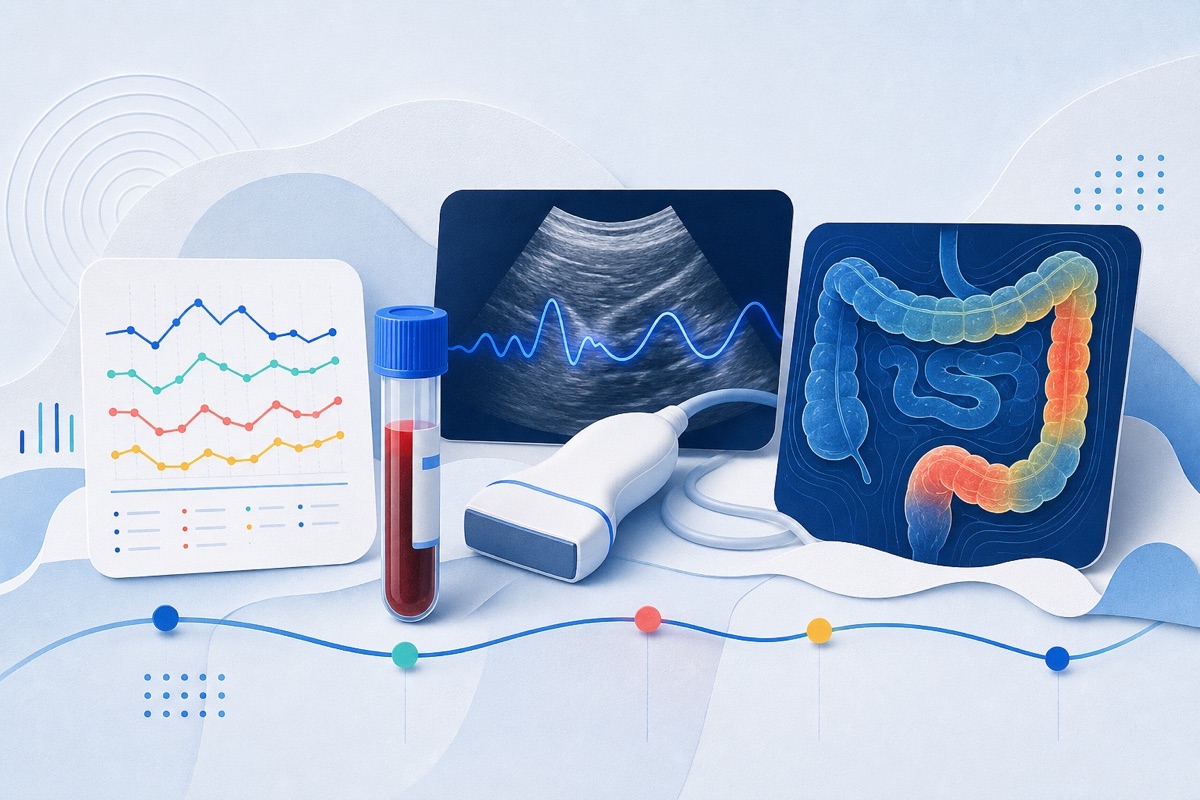
If confirmed, a simple blood marker (NLR) plus biopsy results could help identify UC patients at higher risk of relapse despite endoscopic improvement, which might guide monitoring or treatment choices.
Who Should Pay Attention
Clinicians who manage UC (gastroenterologists), researchers studying biomarkers and relapse prediction, and adult UC patients interested in relapse risk assessment.
Study Snapshot
Story typeResearch paper
Evidence typeResearch paper
Source depthJournal abstract
What To Know
This study assessed whether simple blood ratios — neutrophil-to-lymphocyte ratio (NLR), lymphocyte-to-monocyte ratio (LMR), and neutrophil-to-platelet ratio (NPR) — predict clinical relapse in ulcerative colitis (UC) patients who had endoscopic improvement (Mayo endoscopic subscore 0–1).
Histologic activity was measured with the Geboes score and patients were grouped as histologic improvement (<3.1) or histologic activity (≥3.1). Key findings reported in the abstract: baseline NLR predicted relapse only among patients with histologic activity, not among those with histologic improvement; LMR and NPR were not associated with relapse.
The authors conclude that combining NLR with histologic assessment could improve relapse risk stratification. What this means for patients and clinicians This is an observational, retrospective cohort study reported as an abstract/full text in Diagnostics (MDPI).
The result suggests that a routinely available blood test (NLR) may have more prognostic value when interpreted alongside biopsy-based histology in patients who look improved on endoscopy. It does not alone establish a new standard of care.
Practical next steps Clinicians and researchers may consider these findings as hypothesis-generating: prospective validation would be needed before changing monitoring or treatment decisions. Patients can discuss with their gastroenterologist whether blood inflammatory indices and histology are being used together at their clinic for risk assessment.
Keep In Mind
This is a retrospective cohort study using the Geboes score for histology and routine blood counts to calculate NLR, LMR, and NPR. As a single observational study, results require prospective validation and do not in themselves mandate changes to care.
Source Details
Review the original publication for the complete reporting, methods, and context.
Funding disclosed by the source: National Research Foundation of Korea, award RS-2023-00248080; award RS-2023-00248080
This Cure8 brief is based on source text from the linked article. Cure8 is informational only and is not a substitute for professional medical advice, diagnosis, or treatment.
A new CE-marked food-intolerance diagnostic could give people with Crohn’s or UC a non-invasive tool to explore dietary triggers alongside clinical care. Regulatory certification means the products met EU safety and...
People with IBD have a higher lifetime risk of colorectal cancer; updated UK guidelines give clinicians and patients evidence-based recommendations on when and how to do surveillance colonoscopy to detect precancerous...
Detecting neoplasia early is a central goal of IBD surveillance; this study suggests virtual chromoendoscopy may find more lesions than dye or white light in real-world practice, which could influence how surveillance is...