
Digestive Diseases and Sciences
Cure8 research brief
Cure8 research brief
Many patients and clinicians seek safer, non-immunosuppressive options for Crohn’s disease. This randomized trial found LDN did not induce endoscopic or clinical remission, though it may reduce fatigue—information that helps set realistic expectations and guide future research.
Adults with Crohn’s disease, clinicians managing IBD, and researchers studying repurposed or symptom-directed therapies.
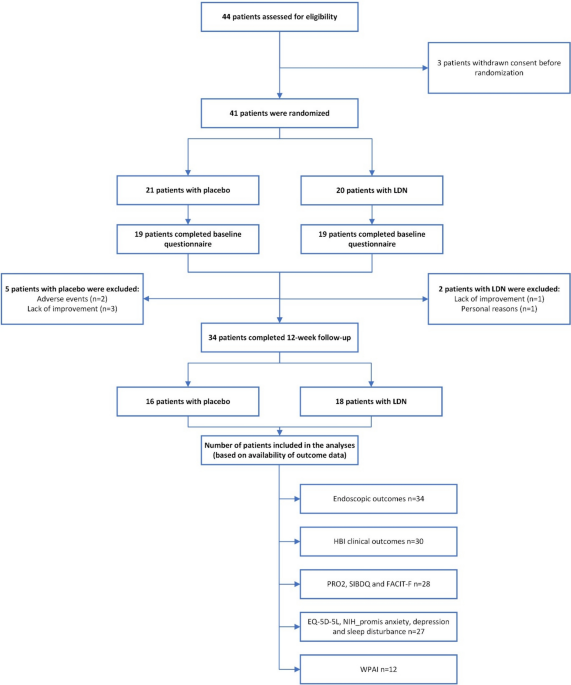
This randomized, placebo-controlled multicenter trial tested low-dose naltrexone (LDN) 4.5 mg daily versus placebo for 12 weeks in adults with mild-to-moderate Crohn’s disease confirmed by endoscopy. The trial was stopped early for futility. LDN did not improve endoscopic or overall clinical remission compared with placebo.
No serious adverse events were reported. A secondary finding was a small improvement in patient-reported fatigue (FACIT-Fatigue) with LDN versus placebo, but other patient-reported outcomes showed no consistent benefit.
Because the study was terminated early and enrolled only 41 patients, it lacked power to detect modest effects on endoscopic healing or clinical remission.
If you’re considering LDN because of concerns about conventional immunosuppression, note that this trial did not support LDN as an effective induction therapy for endoscopic or clinical remission in Crohn’s disease; any potential role may be limited to symptom domains like fatigue and requires further study.
Premature trial termination and small sample size reduce confidence in both the negative primary outcome and the secondary fatigue finding. The fatigue result is hypothesis-generating and not proof of clinical benefit.
Review the original publication for the complete reporting, methods, and context.
Funding disclosed by the source: ZonMw, award 848082001
This Cure8 brief is based on source text from the linked article. Cure8 is informational only and is not a substitute for professional medical advice, diagnosis, or treatment.
Many people on ustekinumab who lose response wonder whether increasing dosing frequency helps. This prospective study suggests that empiric intensification to every 4 or 6 weeks raised drug levels and was linked with...
This study tests a common clinical question: whether increasing vedolizumab frequency helps patients who show no endoscopic response after 6 months. The results suggest intensification raised drug levels but did not...
This trial directly tests common clinical strategies for managing loss of response to ustekinumab in Crohn’s disease. The findings may change whether doctors routinely escalate to 4-weekly dosing after an IV reinduction,...
