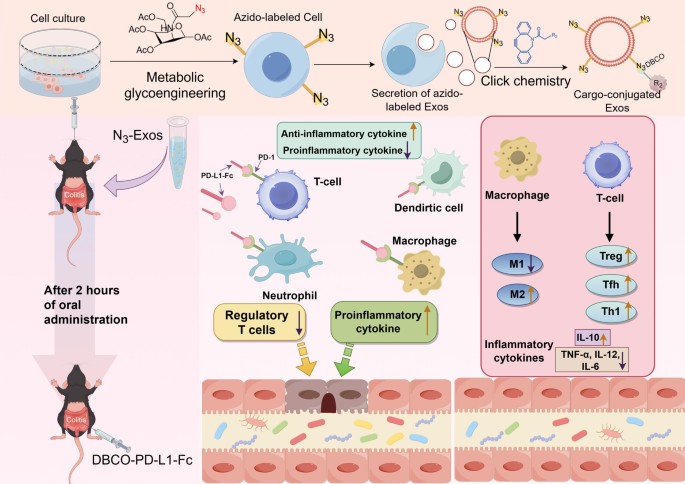
This study presents a targeted immunotherapy approach designed to concentrate an immune‑modulating protein (PD‑L1‑Fc) in the inflamed colon, which could in future reduce systemic side effects of biologic immunomodulators used in ulcerative colitis.
Who Should Pay Attention
Researchers in IBD immunotherapy and drug delivery, translational scientists, and clinicians interested in novel localized biologic strategies
Study Snapshot
Story typeResearch paper
Evidence typeResearch paper
Source depthMetadata only
What To Know
The study reports a two‑step in vivo targeting method: orally delivered azide‑modified exosomes accumulate in inflamed colonic segments; a separately administered DBCO‑modified PD‑L1‑Fc then clicks to the exosomes in situ, producing PD‑L1‑Fc–decorated exosomes at the lesion.
In the authors’ murine colitis model, this approach was associated with improved clinical and histological metrics, shifts in local immune cell populations (including more regulatory T cells and M2 macrophages), increased IL‑10, reduced proinflammatory cytokines, and changes in the gut microbiota toward taxa linked with mucus protection and short‑chain fatty acid production.
The work is preclinical and presented as a proof‑of‑concept in mice using engineered exosomes and bioorthogonal chemistry. The paper is published in the Journal of Nanobiotechnology and reports experimental outcomes in an animal model; it does not provide human clinical data.
Keep In Mind
this is preclinical work in mice using engineered exosomes and chemical click reactions; it demonstrates proof‑of‑concept biological effects but not safety, dosing, or efficacy in humans.
Source Details
Review the original publication for the complete reporting, methods, and context.
Funding disclosed by the source: Natural Science Foundation of Shandong Province, award NO. ZR2025QC1765; Natural Science Foundation of Shandong Province, award NO. ZR2025MS1272; National Natural Science Foundation of China, award NO. 32500811; the Science and Technology Co-construction Project of the Department of Science and Technology, award NO. GZY-KJS-SD-2024-103; the Clinical Medical Science and Technology Innovation Project of Jinan, award NO. 202512040
This Cure8 brief is based on source text from the linked article. Cure8 is informational only and is not a substitute for professional medical advice, diagnosis, or treatment.
This study describes a local rectal therapy that combines mesalamine with probiotic‑derived extracellular vesicles to promote mucosal healing and reduce inflammation in ulcerative colitis models, which could point toward...
Localized rectal delivery of probiotic-derived vesicles combined with mesalamine may offer a way to reduce inflammation and help mucosal healing in ulcerative colitis using a stable, off-the-shelf formulation. This could...
Researchers are exploring methods to make probiotic therapies more stable through the digestive tract and to deliver anti-inflammatory molecules directly where intestinal inflammation produces high reactive oxygen...