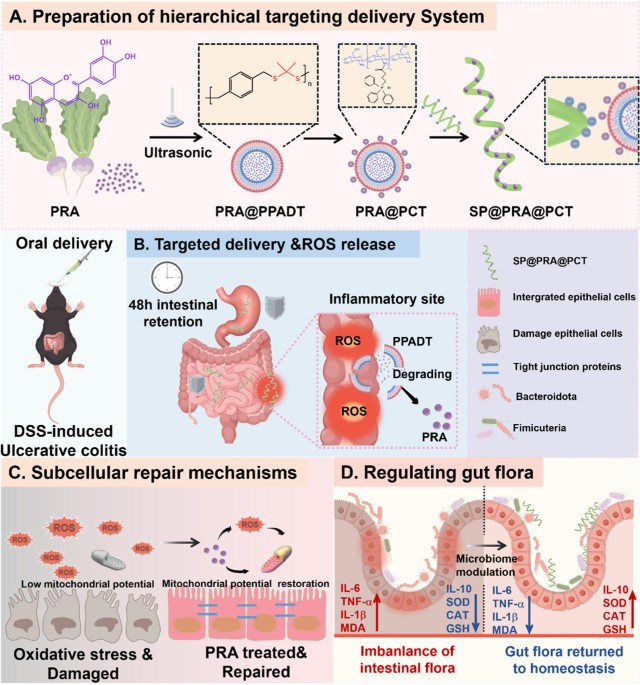
The study proposes a targeted oral delivery method that could help concentrate anti-inflammatory natural compounds at inflamed colon sites, potentially improving treatment effectiveness for ulcerative colitis while overcoming poor oral stability of such compounds.
Who Should Pay Attention
Researchers working on nanodelivery and IBD therapies, clinicians following translational IBD treatments, and patients interested in emerging drug-delivery technologies.
Study Snapshot
Story typeResearch paper
Evidence typeResearch paper
Source depthMetadata only
What To Know
The authors developed a hierarchical system (SP@PRA@PCT) combining Spirulina platensis and ROS-responsive nanoparticles loaded with purple radish anthocyanin. The design aims to increase gastrointestinal stability, prolong intestinal residence via microalgae bioadhesion, target mitochondria, and release cargo in response to high ROS in inflamed tissue.
In cell experiments the system scavenged ROS, reduced mitochondrial dysfunction, supported epithelial cell migration, modulated inflammatory cytokine expression, and lowered apoptosis.
In a DSS mouse colitis model the formulation increased intestinal retention time and produced better outcomes (colon length preservation, lower disease activity index, improved barrier integrity) versus free anthocyanin or non-targeted controls, and altered gut microbiota composition toward more beneficial bacteria.
Keep In Mind
Findings are from in vitro experiments and a DSS-induced mouse model; the article is preclinical and does not report human trials. Results are promising but require further safety and efficacy testing before clinical use.
Source Details
Review the original publication for the complete reporting, methods, and context.
Funding disclosed by the source: Natural Science Foundation of Shanxi Province, award 202303021212344; Natural Science Foundation of Shanxi Province, award 202303021222322
This Cure8 brief is based on source text from the linked article. Cure8 is informational only and is not a substitute for professional medical advice, diagnosis, or treatment.
Researchers are exploring methods to make probiotic therapies more stable through the digestive tract and to deliver anti-inflammatory molecules directly where intestinal inflammation produces high reactive oxygen...
This study describes a new plant-derived nanoparticle (EBDEVs) that reduced inflammation and improved colon health in a mouse model of ulcerative colitis and altered the gut microbiota — early evidence that may guide...
This study describes a local rectal therapy that combines mesalamine with probiotic‑derived extracellular vesicles to promote mucosal healing and reduce inflammation in ulcerative colitis models, which could point toward...