
Clinical Pharmacokinetics
Cure8 research brief
Cure8 research brief
Vedolizumab blood levels can vary with disease activity; a model that links intestinal α4β7 expression to drug exposure helps explain why some patients have lower drug levels and may need different dosing. This could inform personalized dosing strategies to improve treatment response in UC and Crohn’s disease.
Clinicians treating adults with moderate-to-severe UC or Crohn’s disease, researchers developing PK/PD models or precision‑dosing approaches, and patients on vedolizumab or interested in biologic drug monitoring.
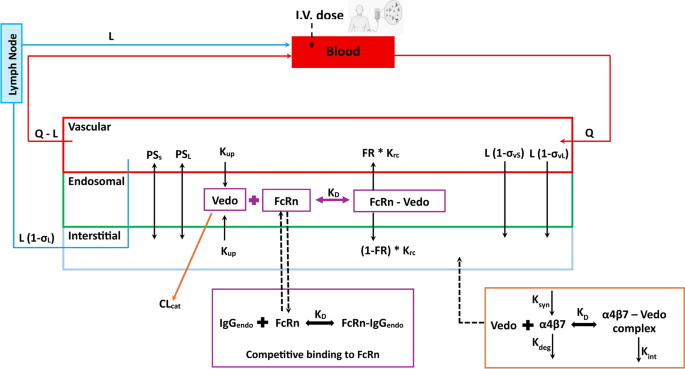
This open‑access Clinical Pharmacokinetics article reports a physiologically based pharmacokinetic (PBPK) model for vedolizumab that incorporates target‑mediated drug disposition (TMDD) and disease‑dependent α4β7 expression.
The authors parameterized and verified the model against clinical pharmacokinetic data, then simulated how increased target abundance in active IBD can raise clearance and lower systemic exposure — sometimes producing trough concentrations below suggested efficacy thresholds.
The paper frames the model as a tool to support model‑informed precision dosing for adults with UC and CD.
This article is a model‑building clinical pharmacokinetics study (open access) that uses published data and simulations; it does not present new randomized trial results or direct clinical dosing recommendations. Model predictions (including thresholds cited) should be interpreted as hypothesis‑generating and would require clinical validation before changing practice.
Review the original publication for the complete reporting, methods, and context.
Funding disclosed by the source: National Institute of Diabetes and Digestive and Kidney Diseases, award DK132408; Japan Research Foundation for Clinical Pharmacology
This Cure8 brief is based on source text from the linked article. Cure8 is informational only and is not a substitute for professional medical advice, diagnosis, or treatment.
Patients, families, and clinicians may care because the study shows pediatric-onset IBD is more often Crohn's and that children begin advanced therapies earlier than adults. The adult persistence data for vedolizumab and...
People with IBD and their clinicians want ways to predict which advanced therapy will work best. This review summarizes current evidence and shows that, despite many studies, no biomarker is reliably ready for routine...
ECCO 2026 presented multiple studies that could change IBD care across prevention, medical therapy (including pediatric data), complication‑directed strategies (perianal fistula), and technology‑assisted monitoring....

