Colloids and surfaces. B, Biointerfaces
Cure8 research brief
Cure8 research brief
This study reports an early-stage nanoplatform that combines targeted colon delivery of an aminosalicylate prodrug with scavenging of proinflammatory cfDNA, a dual strategy that reduced colitis severity in mice and could point toward new local therapies for IBD if translated safely to humans.
Researchers working on IBD drug delivery or immunomodulation, translational scientists developing nanoparticle therapeutics, and clinicians interested in emerging local therapies for ulcerative colitis/IBD.
The authors built a hybrid nanoplatform (mesoporous silica nanoparticle core, polyethyleneimine polymer, and an Eudragit coating) designed to flip surface charge in the colon, release an aminosalicylate prodrug (olsalazine sodium) there, and bind anionic cfDNA to modulate macrophages and protect the mucosal barrier.
Results reported are from lab experiments and a mouse colitis model; the paper presents proof-of-concept protective effects on intestinal mucosa in that animal model. More work is needed to evaluate safety, dosing, delivery, and efficacy in humans before this could affect clinical care.
Structured content depth: abstract — the brief is grounded in the source-provided abstract and reports a proof-of-concept animal study. This is basic-science/preclinical work; it has not demonstrated safety or efficacy in humans.
Review the original publication for the complete reporting, methods, and context.
This Cure8 brief is based on source text from the linked article. Cure8 is informational only and is not a substitute for professional medical advice, diagnosis, or treatment.
The paper reports a material that preserved barrier proteins and reduced inflammatory signaling in cell and mouse models of ulcerative colitis; this could point to a low-cost adjunct approach for protecting the colonic...
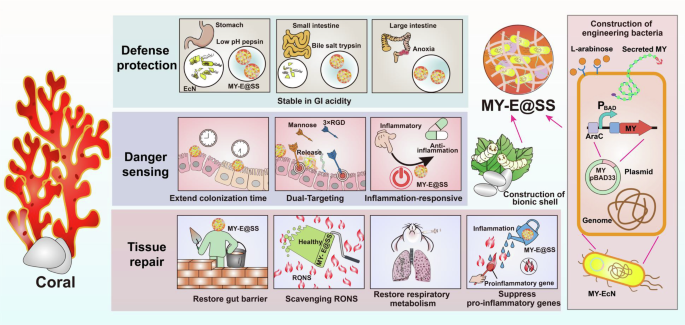
This study presents an engineered probiotic delivery platform that could improve survival and targeted action of live microbial therapies for IBD, potentially reducing local inflammation while affecting the gut...
This research explores a novel way to deliver probiotics and antioxidant molecules directly to inflamed colon lesions — a potential path to therapies that locally reduce oxidative stress and inflammation in IBD without...