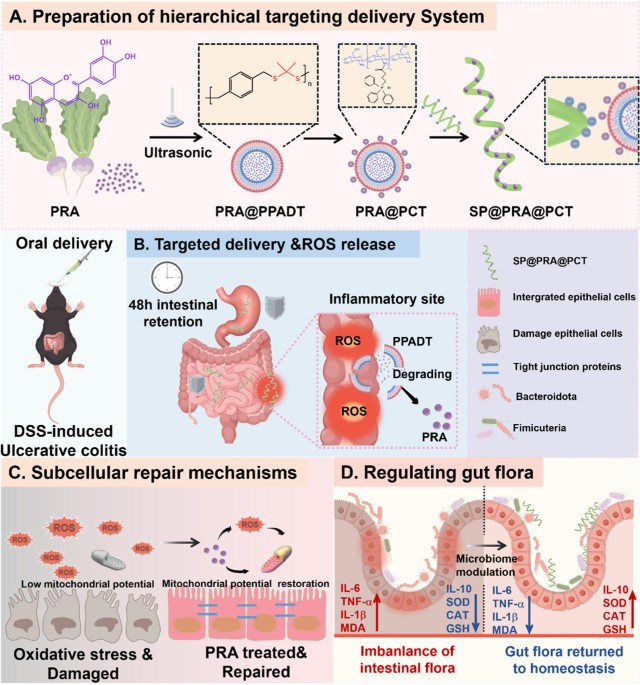
This study describes a novel colon-targeted microgel delivery system carrying an anti-inflammatory natural compound that, in a mouse model, reduced colitis signs and altered gut bacteria — a potential new strategy for localized therapy in UC/IBD.
Who Should Pay Attention
Researchers and clinicians focused on IBD therapeutics and drug-delivery; patients interested in experimental colon-targeted treatments.
Study Snapshot
Story typeResearch paper
Evidence typeResearch paper
Source depthJournal abstract
What To Know
This paper reports an engineered oral adhesive bilayer microgel (Cp@GTL) designed to deliver costunolide — a naturally derived anti-inflammatory compound — to the colon.
The system combines a pH-resistant outer shell (alginate–chitosan) and an enzyme-responsive mucoadhesive inner gel (gelatin–low‑methoxyl pectin) to retain drug at the colon, slow upper-GI release, and trigger release in the colon.
In a DSS mouse model of ulcerative colitis reported in the abstract, the microgels increased colonic drug accumulation and retention (up to 48 hours), reduced colitis signs and pro-inflammatory cytokines, and altered gut microbiota composition toward greater diversity with fewer pathogenic bacteria.
The authors propose this as a platform for colon-targeted delivery of costunolide and related intestinal anti-inflammatory applications. This summary is grounded in the source-provided abstract (structured content depth: abstract). It does not represent a full review of the article or independent verification of methods or results.
Keep In Mind
Results are reported from preclinical (DSS mouse) experiments summarized in the article abstract; they are promising but not evidence of safety or effectiveness in humans.
Source Details
Review the original publication for the complete reporting, methods, and context.
Funding disclosed by the source: Natural Science Foundation of Hubei Province, award 2022CFB464; Health and Family Planning Commission of Hubei Province, award ZY2019M031; Fundamental Research Funds for the Central Universities, award CZZ24018
This Cure8 brief is based on source text from the linked article. Cure8 is informational only and is not a substitute for professional medical advice, diagnosis, or treatment.
This study describes a local rectal therapy that combines mesalamine with probiotic‑derived extracellular vesicles to promote mucosal healing and reduce inflammation in ulcerative colitis models, which could point toward...
The study proposes a targeted oral delivery method that could help concentrate anti-inflammatory natural compounds at inflamed colon sites, potentially improving treatment effectiveness for ulcerative colitis while...
This study describes a new plant-derived nanoparticle (EBDEVs) that reduced inflammation and improved colon health in a mouse model of ulcerative colitis and altered the gut microbiota — early evidence that may guide...