medscape.com
Cure8 news brief
Patient Scores Can Make Crohn's Tracking Easy in Real World
Tests and monitoring
Abdominal Pain
Clinical study
Clinicians
Adult patients
Patients On Biologics
Newly Diagnosed
Crohn's disease
Cure8 news brief
Simpler patient-reported scores (PRO2/PRO3) were much more often available in routine clinic visits than CDAI or HBI, yet they agreed closely with those indices. That could make regular monitoring and telehealth follow-up easier for people with Crohn’s disease.
Clinicians monitoring Crohn’s disease, adult patients with Crohn’s disease interested in symptom tracking or telehealth, and researchers of disease-activity measures.
A large real-world study compared standard clinician-based indices (CDAI and HBI) with two simplified patient-reported outcome scores (PRO2 and PRO3) using >26,000 Crohn’s clinic visits from electronic records in Australia and New Zealand.
PRO2/PRO3 could be calculated in ~81% of visits versus ~25% for CDAI/HBI, and they showed high agreement with the traditional scores for categorizing disease severity.
PRO2 and PRO3 use only patient-reported liquid stools (past 24 hours), average abdominal pain (7 days), and general well‑being (7 days); they therefore require no lab values or physical-exam inputs.
The investigators report most mismatches with CDAI/HBI were minor (off by one severity level), and statistical analyses indicated close tracking between the measures. If confirmed and adopted, PRO2/PRO3 could make routine and telehealth monitoring easier and more scalable because they are simpler to collect repeatedly.
The article notes the research was published in Gastro Hep Advances and was based on retrospective electronic medical record data; funding was not reported and some authors had industry disclosures.
The study used retrospective EMR data from Australia and New Zealand and was published in Gastro Hep Advances. The provided article text did not list explicit limitations; the findings are encouraging for feasibility but should be considered in light of possible data-capture biases and the observational design.
Review the original publication for the complete reporting, methods, and context.
This Cure8 brief is based on source text from the linked article. Cure8 is informational only and is not a substitute for professional medical advice, diagnosis, or treatment.
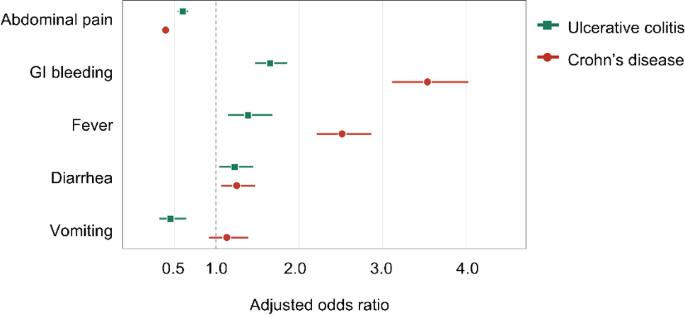
The study suggests ED presentation symptoms predict admission differently in UC versus CD, which could affect triage and short-term risk assessment for IBD patients. Knowing which symptoms are stronger predictors by...
CT-detected terminal ileitis was due to Crohn’s disease in only a small minority (12.5%) of cases in this cohort, so most patients with this imaging finding will need further testing to determine the cause.
The study suggests a blood cytokine (CXCL9) could help noninvasively detect intestinal inflammation in Crohn’s disease, which might one day reduce reliance on colonoscopy for monitoring disease activity.