healio.com
Cure8 news brief
Intestinal ultrasound assists in monitoring Crohn's disease
Tests and monitoring
Intestinal ultrasound
Fecal calprotectin
CRP
Colonoscopy
Patient Education
Adult patients
Clinicians
Cure8 news brief
Intestinal ultrasound provides a noninvasive, real-time way to see bowel inflammation and may reveal treatment response earlier than symptoms alone. That can help clinicians make timely treatment changes to prevent long-term bowel damage.
The article also underscores combining imaging with biomarkers and periodic colonoscopy to aim for mucosal healing.
Adults with Crohn’s disease, clinicians who manage IBD (gastroenterologists, IBD nurses), and patients starting or changing therapy who need closer objective monitoring.
This Healio piece (video transcript) highlights intestinal/transabdominal ultrasound as a practical, bedside tool to monitor Crohn’s disease activity alongside biomarkers and colonoscopy.
The speaker describes using ultrasound to track bowel wall thickness and blood flow to detect early treatment response (often within weeks), reducing reliance on symptoms alone and allowing earlier treatment decisions.
She frames monitoring in short-, intermediate- and long-term phases: early clinical response (weeks–3 months), objective improvement including fecal calprotectin/CRP and ultrasound (3–6 months), and endoscopic healing assessed by colonoscopy around 6–9 months per STRIDE-2.
The transcript also reminds clinicians to monitor safety (labs, infections) and address nutrition, bone health, vaccinations, skin and cancer screening.
This is a clinician-led video/transcript describing practice perspectives rather than a primary research report; statements reflect the speaker’s practice and guideline-aligned monitoring targets (STRIDE-2). Availability of intestinal ultrasound and operator experience vary by center; it complements but does not replace colonoscopy or biomarker testing.
Review the original publication for the complete reporting, methods, and context.
This Cure8 brief is based on source text from the linked article. Cure8 is informational only and is not a substitute for professional medical advice, diagnosis, or treatment.
The study will test whether routine point‑of‑care intestinal ultrasound changes clinical decisions compared with standard monitoring, which could make monitoring less invasive and more responsive if effective.
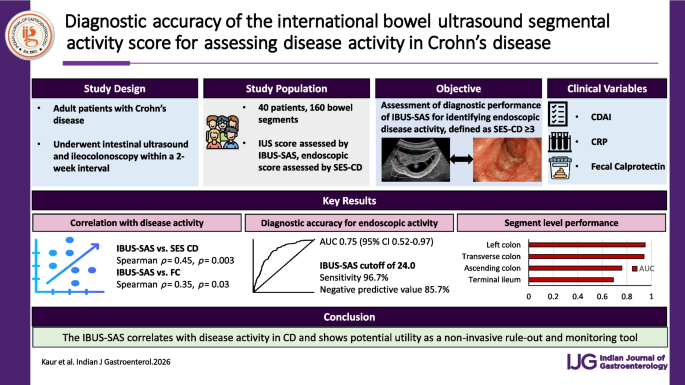
Standardized intestinal ultrasound scoring could help non-invasively monitor Crohn’s disease activity and reduce reliance on colonoscopy for some assessments. A high-sensitivity IUS score may be useful to rule out...
People with IBD who have no or few symptoms but still have moderate–severe inflammation on endoscopy face uncertainty about whether to switch therapies to aim for endoscopic remission.