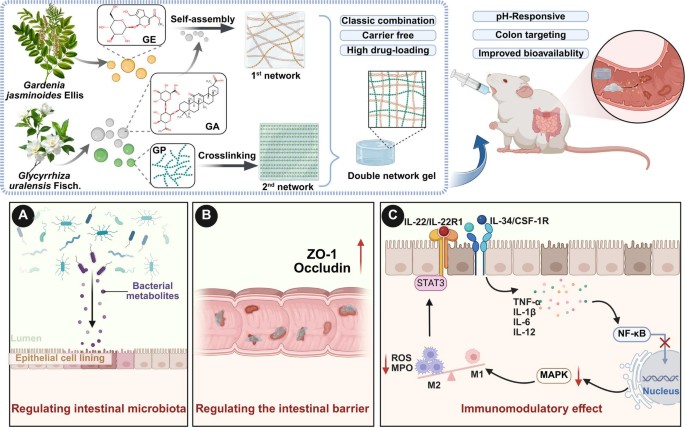
This study reports a new herbal hydrogel designed to repair the intestinal barrier, shift gut microbes, and modulate immune signals (IL-22/IL-34) in preclinical models of ulcerative colitis—ideas that could inform future therapies.
For people with UC, it highlights active research into nonstandard, multimodal approaches targeting mucosal healing and immune regulation.
Who Should Pay Attention
Researchers (biomaterials, immunology, microbiome), translational scientists, clinicians following preclinical advances in UC, and informed patients curious about future therapeutic directions.
Study Snapshot
Story typeResearch paper
Evidence typeResearch paper
Source depthMetadata only
What To Know
This open‑access Journal of Nanobiotechnology article describes a preclinical, lab-and-animal study of a dual-crosslinked herbal hydrogel (GG gel) made from Gardenia polysaccharide, glycyrrhizic acid, and geniposide intended to treat ulcerative colitis.
The authors report that the gel is pH‑responsive, enhances epithelial penetration, modulates gut microbiota, promotes IL-22 expression (linked to mucosal repair), suppresses IL-34 (linked to inflammation), and influences macrophage polarization in their experimental models.
The paper frames the approach as a multimodal, natural‑product hydrogel that aims to restore barrier function, rebalance microbiota, and modulate immune signaling (IL-22/IL-34) rather than a conventional single-drug therapy.
Methods and claims are presented at the preclinical/mechanistic level (in vitro and in vivo animal evaluations) rather than clinical evidence in people. If you’re reading as a patient: this is early-stage research showing a potential new material and biological pathway targets for UC therapy in laboratory and animal work.
It does not mean this is available or proven safe and effective in people yet.
Keep In Mind
Preclinical study (in vitro and in vivo animal work) published in a peer-reviewed journal. Not a clinical trial; safety and efficacy in humans are not assessed here. The paper emphasizes mechanistic pathways (IL-22, IL-34) and microbiome effects rather than clinical outcomes.
Source Details
Review the original publication for the complete reporting, methods, and context.
Funding disclosed by the source: China Postdoctoral Science Foundation, award 2025M783901; Zhejiang Chinese Medical University, award 2025RCZXZK65; Zhejiang Chinese Medical University, award 2024RCZXZK66; National Natural Science Foundation of China, award 82505380; Natural Science Foundation of Zhejiang Province, award LJHSQY26H270002; National Key Research and Development Program of China, award 2023YFC3503904; Science and Technology Program of Zhejiang Province, award 2025C02182
This Cure8 brief is based on source text from the linked article. Cure8 is informational only and is not a substitute for professional medical advice, diagnosis, or treatment.
The study describes a new localized delivery system combining probiotic‑derived extracellular vesicles with mesalamine that reduced inflammation and promoted mucosal healing in experimental models, suggesting a potential...
Localized rectal delivery of probiotic-derived vesicles combined with mesalamine may offer a way to reduce inflammation and help mucosal healing in ulcerative colitis using a stable, off-the-shelf formulation. This could...
The study suggests a Moringa-derived polysaccharide may reduce inflammation in a mouse model of ulcerative colitis by altering gut microbiota, metabolites, and inflammatory/antioxidant signaling — a potential preclinical...