This work organizes preclinical evidence connecting Atractylodes macrocephala constituents to intestinal barrier protection, immune modulation, and microbiota changes relevant to ulcerative colitis—useful for researchers and clinicians watching natural-product targets that might inform future therapies.
Who Should Pay Attention
Researchers studying natural products, microbiome or immune mechanisms in IBD; clinicians curious about translational targets; adult patients interested in mechanistic research on botanical constituents (not clinical recommendations).
Study Snapshot
Story typeResearch paper
Evidence typeResearch paper
Source depthJournal abstract
What To Know
This is a mechanistic review mostly based on preclinical colitis models and biochemical studies of individual plant constituents (e.g., atractylenolides, polysaccharides, volatile oils). The authors grade evidence strength and explicitly note where findings are extrapolated rather than proven in humans.
Controlled human trials are not reported; clinical observations remain preliminary. The review singles out endothelial–leukocyte adhesion as a potentially tractable translational target because anti-adhesion biologics already act on related pathways.
If you’re interested in plant-derived bioactives for UC, this paper maps candidate mechanisms and prioritizes steps needed before clinical testing, but it does not provide clinical-effectiveness or safety data.
Keep In Mind
This is a preprint/abstract-level review grounded in laboratory and animal colitis models; controlled human trials are lacking and clinical relevance remains unproven. The authors note extrapolations and grade evidence strength.
Source Details
Review the original publication for the complete reporting, methods, and context.
This Cure8 brief is based on source text from the linked article. Cure8 is informational only and is not a substitute for professional medical advice, diagnosis, or treatment.
People with IBD might be interested because the study explores a new natural-product intervention that appears to reduce colitis severity in an animal model by activating the Nrf2 antioxidant pathway — a pathway already...
A plant polysaccharide (PVP) reduced inflammation and preserved intestinal barrier proteins in a mouse model of ulcerative colitis, apparently by increasing a specific gut bacterium. This points to a microbiome-related...
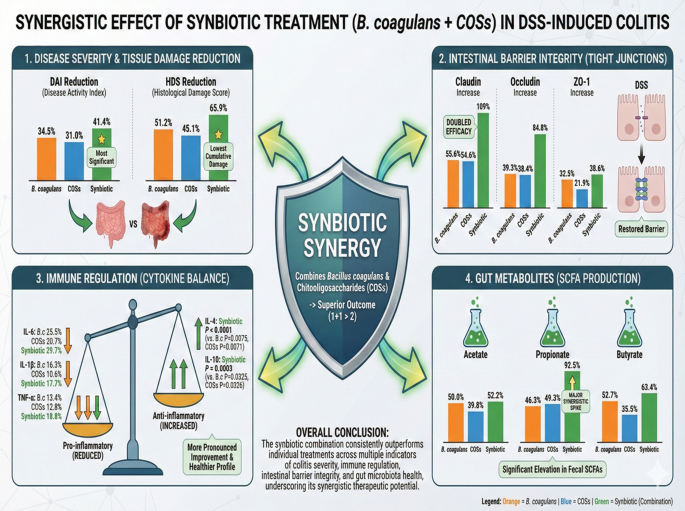
People with ulcerative colitis may be interested because synbiotic approaches aim to change the gut microbiome and intestinal barrier and therefore could become a future therapeutic option or adjunct. The paper...