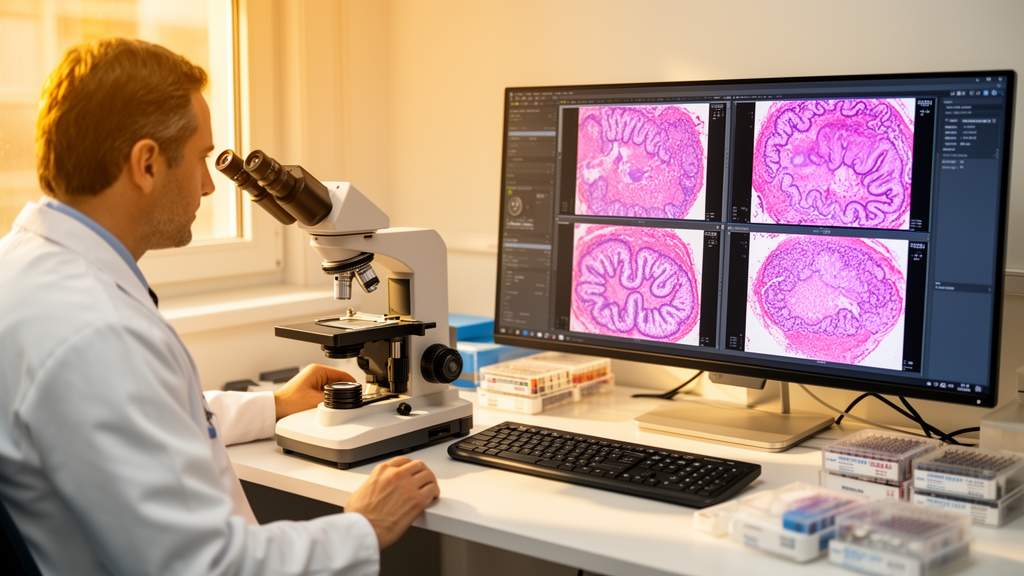
Accurate, consistent severity grading at diagnosis shapes initial treatment decisions in Crohn’s disease. AI that can reproduce expert severity assessments from small labeled datasets could help standardize grading and support clinicians, especially where expert panels aren’t available.
The finding that imaging (CT enterography) strongly contributes to detecting severe disease highlights that AI tools may still need cross-sectional imaging to reliably flag patients who need urgent escalation.
Who Should Pay Attention
Gastroenterologists and IBD clinicians, clinical researchers developing AI or diagnostic tools, and patients newly diagnosed with Crohn’s disease or their caregivers interested in diagnostic advancements.
Study Snapshot
Story typeResearch paper
Evidence typeClinical study
Source depthFull source text
What To Know
A new Journal of Translational Medicine study from a Chinese center used few-shot learning methods (metric learning, matching networks, prototypical networks) to classify Crohn’s disease severity from routinely collected clinical data and imaging.
The prototypical network performed best; the authors used SHAP to identify which input features influenced predictions. Removing CT enterography features reduced performance for identifying severe disease, suggesting imaging remains important for detecting high-severity cases.
The study used a small retrospective dataset (106 newly diagnosed patients with expert-consensus severity labels) and evaluated models with nested cross-validation and a separate temporally independent cohort (n=23) for ablation testing.
Authors note risk of incorporation bias because some predictors overlap with the expert labels the model learned to reproduce. This is promising early work showing that few-shot AI methods can learn severity patterns from limited labeled data and that model interpretability (SHAP) can help clinicians see which variables drive predictions.
It does not establish clinical readiness; further external validation, prospective testing, and assessment of clinical impact are needed.
Keep In Mind
The report is a single-center retrospective study with a small sample size and possible incorporation bias (clinical data used both to create labels and as model inputs). The model was evaluated with nested cross-validation and a small temporally independent cohort, but broader external and prospective validation is required before clinical deployment.
Source Details
Review the original publication for the complete reporting, methods, and context.
Clinical studyArticle type assigned from Cure8 classification; confirm details in the original source.
Publicationbioengineer.org
Indexed viaGoogle News
Source typeWeb article
PublishedOct 9, 2026, 8:03 AM
Content availableFull source text
This Cure8 brief is based on source text from the linked article. Cure8 is informational only and is not a substitute for professional medical advice, diagnosis, or treatment.
AI models that combine CTE/MRE imaging with clinical and molecular data could improve objective classification of small-bowel Crohn's disease and help predict which patients are likely to respond to medical therapy...
A coordinated national research network can accelerate studies that matter to people with IBD—like tracking real-world disease patterns, testing diet and psychosocial approaches, improving monitoring with biomarkers and...
AI could help make IBD assessments (endoscopy, histology, imaging, biomarkers) more objective and faster, which may improve monitoring, treatment selection, and early detection of complications for people with Crohn’s...