Researchers and clinicians are exploring cGAS/STING as a novel immune pathway linked to mucosal barrier function and inflammation in UC. Modulators of this pathway could become future targeted treatments, so patients and providers may want to follow this area as it develops.
Who Should Pay Attention
Researchers studying immune mechanisms or drug discovery in IBD; clinicians interested in emerging molecular targets for UC; adult patients following research on new therapeutic approaches.
Study Snapshot
Story typeResearch paper
Evidence typeResearch paper
Source depthJournal abstract
What To Know
The paper frames cGAS/STING as an immune signaling pathway that can both support mucosal barrier homeostasis and drive inflammation in UC. It reviews upstream triggers (exogenous and leaked endogenous DNA), downstream intestinal defense effects, and interactions with the gut microbiome.
The authors summarize existing small molecules and natural products under investigation that modulate cGAS/STING, presenting this axis as a potential target for future precision therapies in UC. Because the article is an abstract-level review, it synthesizes current research rather than reporting new clinical trial results.
Keep In Mind
This is an abstract-level review article summarizing preclinical and early-stage pharmacological work. It does not present new clinical trial results; proposed therapies need clinical testing.
Source Details
Review the original publication for the complete reporting, methods, and context.
Funding disclosed by the source: National Natural Science Foundation of China, award 82341233; award 82341233; China Academy of Chinese Medical Sciences, award CI2026A01013; award CI2026A01013; Xiyuan Hospital, award XYZX0405-34; award XYZX0405-34; China Academy of Chinese Medical Sciences, award ZZ15-YQ-002; award ZZ15-YQ-002
This Cure8 brief is based on source text from the linked article. Cure8 is informational only and is not a substitute for professional medical advice, diagnosis, or treatment.
ER stress in intestinal epithelial cells is proposed as a key molecular mechanism in UC development; targeting ER pathways (notably IRE1β) could eventually lead to new treatments that strengthen the gut barrier and...
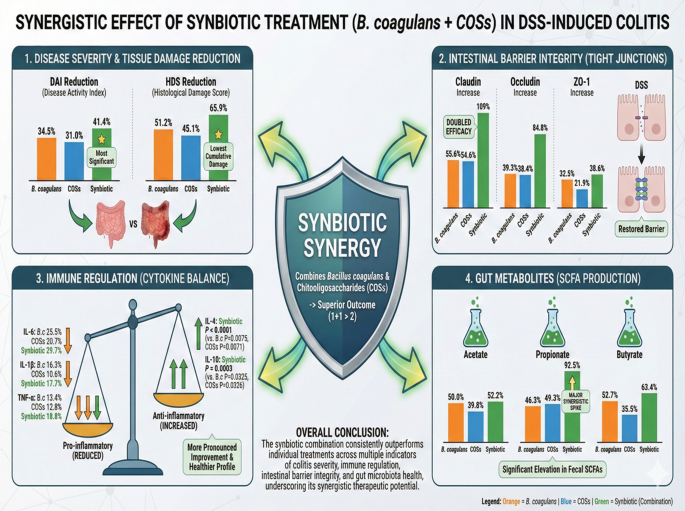
People with ulcerative colitis may be interested because synbiotic approaches aim to change the gut microbiome and intestinal barrier and therefore could become a future therapeutic option or adjunct. The paper...