If you or a patient is about to start infliximab for ulcerative colitis, routine blood counts may help identify those unlikely to respond to induction therapy; a high negative predictive value suggests these markers could help rule out non‑response, pending external validation.
Who Should Pay Attention
Adult patients with ulcerative colitis starting infliximab, gastroenterologists and IBD clinicians, and researchers studying blood biomarkers for treatment response.
Study Snapshot
Story typeResearch paper
Evidence typeResearch paper
Source depthJournal abstract
What To Know
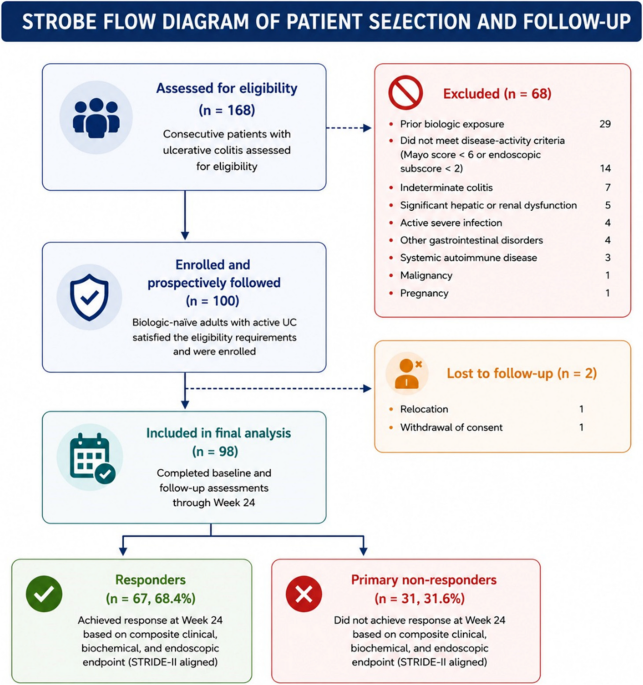
This study enrolled 98 biologic‑naïve adults with moderate–severe ulcerative colitis starting infliximab and compared baseline composite blood indices (neutrophil-to-albumin ratio [NAR], systemic immune‑inflammation index [SII], pan‑immune‑inflammation value [PIV]) and their components for predicting primary non‑response at week 24 using clinical–endoscopic criteria.
Key findings reported in the abstract: baseline neutrophil‑based markers (NAR and absolute neutrophil count) discriminated patients who later had primary non‑response; NAR and neutrophil count performed equivalently and composite indices offered no clear advantage over the absolute neutrophil count.
The authors report an exploratory NAR threshold (≥1.04) with high negative predictive value (92.3%) and recommend external validation. Practical note: the report frames these indices as potential, easily available rule‑out tools based on routine labs rather than ready-to-use clinical decision rules.
The threshold and clinical utility need validation in other populations before being used to change treatment plans.
Keep In Mind
This is a single prospective cohort (n=98) with findings reported in the article abstract; the suggested NAR threshold is exploratory and requires external validation before clinical adoption. The study compares composite indices to their component neutrophil count and albumin at baseline and during treatment.
Source Details
Review the original publication for the complete reporting, methods, and context.
This Cure8 brief is based on source text from the linked article. Cure8 is informational only and is not a substitute for professional medical advice, diagnosis, or treatment.
Based on the title and source metadata, this appears to be a clinical study related to Ulcerative colitis, Inflammatory bowel disease, and Infliximab. The original article is from Translational gastroenterology and...
Early, noninvasive stool tests (fecal calprotectin and FIT) might identify whether vedolizumab or infliximab is likely to work within weeks instead of months. That could let patients and clinicians make treatment...
Early changes in stool tests (qFIT and fecal calprotectin) might help predict which biologic‑naive ulcerative colitis patients will relapse or need escalation to biologic/JAK therapy. If validated, such markers could...