The review suggests that cGAS–STING can be either harmful or helpful in IBD depending on context, so therapies that broadly block STING could have unwanted effects on host defense, tolerance, mucosal repair, or cancer surveillance.
Patients should know that targeting this pathway would require carefully targeted approaches and better biomarkers before clinical use.
Who Should Pay Attention
Researchers studying innate immune pathways in IBD, translational scientists developing STING-targeted therapies, clinicians interested in emerging mechanism-based treatments, and patients/research-savvy caregivers following IBD drug development.
Study Snapshot
Story typeResearch paper
Evidence typeResearch paper
Source depthJournal abstract
What To Know
This review examines cGAS–STING signaling in IBD and argues that its effects depend on cell type, subcellular signaling location, lesion state, and timing.
Experimental-colitis models with sustained DNA exposure most consistently show pathogenic roles, while other STING outputs (for example nuclear STING in epithelial cells, T-cell–intrinsic STING, or ILC3 sensing) may promote antimicrobial defense, tolerance, or repair.
The authors emphasize that increased expression of cGAS/STING or interferon-stimulated genes in human tissue does not prove active cGAMP production, STING trafficking/phosphorylation, or downstream TBK1–IRF3 activation — and therefore is insufficient to infer causality.
They recommend developing cell-resolved target-engagement biomarkers and testing locally delivered, time-limited interventions in longitudinal human tissue and models that preserve microbiota and lesion heterogeneity.
This is a conceptual, evidence-synthesis paper (review) rather than a report of a clinical trial or new human experimental results; it focuses on mechanistic heterogeneity and translational implications.
Keep In Mind
Structured-content depth: abstract — this brief is grounded in the article abstract and review text on Europe PMC, not a full independent appraisal of underlying experimental studies. Human evidence cited in the review is mainly cross-sectional and heterogeneous between UC and Crohn’s, limiting causal conclusions.
Source Details
Review the original publication for the complete reporting, methods, and context.
This Cure8 brief is based on source text from the linked article. Cure8 is informational only and is not a substitute for professional medical advice, diagnosis, or treatment.
Spatially resolved profiling could identify the specific cell neighborhoods and signaling circuits that drive disease in a person’s gut tissue, which may help predict who will respond to particular biologics or small...
This review spotlights non-bacterial members of the gut microbiota (viruses and fungi) that may contribute to IBD by altering barrier function, immune responses, and interactions with bacteria. For people with IBD, these...
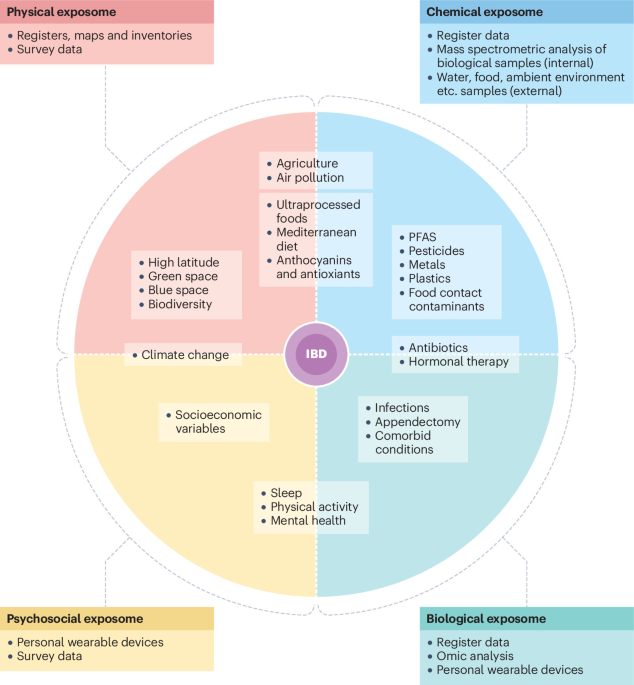
The exposome perspective emphasizes that many non-genetic, potentially modifiable environmental factors likely influence IBD risk. Understanding these factors could help guide prevention research and public-health...