Development of double emulsions loaded with Malus baccata (Linn.) polyphenols and their protective effect on dextran sulfate sodium-induced ulcerative colitis in mice.
Researchers are exploring plant polyphenols and new oral delivery systems that might reduce gut inflammation and modify microbiota — findings in mice suggest potential but are not directly applicable to patients yet.
This study highlights a formulation that improved several inflammation-related measures in a mouse model of ulcerative colitis.
Who Should Pay Attention
Researchers studying IBD therapeutics or drug delivery, clinicians interested in preclinical developments, and patients curious about emerging nutraceutical research (note: preclinical only).
Study Snapshot
Story typeResearch paper
Evidence typeResearch paper
Source depthJournal abstract
What To Know
This PubMed abstract reports a preclinical (mouse) study testing a double (W/O/W) emulsion delivery system carrying Malus baccata polyphenols (MBP).
The selected formulation (MHSG DEs) showed good physical stability and, when given to DSS-induced ulcerative colitis mice, was associated with reduced disease activity index, less weight loss, increased expression of tight-junction proteins, higher short-chain fatty acids, improved blood parameters, and changes in gut microbiota.
These results come from an animal model and do not establish safety or efficacy in people. The paper focuses on a delivery formulation (nanoparticle-stabilized double emulsion) and reports biological effects in mice rather than a human trial. The authors note that mechanisms and superiority over other interventions remain to be confirmed.
If you have Crohn's disease or ulcerative colitis, this is an early-stage research finding showing a potential nutraceutical delivery approach that altered gut inflammation and microbiota in mice; it is not a clinical therapy and should not change treatment decisions.
The study may be of interest to researchers working on oral delivery systems, polyphenol therapeutics, microbiome-mediated treatments, and preclinical IBD models.
Keep In Mind
This is a preclinical animal study (DSS-induced colitis in mice) reported in a PubMed-indexed journal; results do not equal human clinical evidence. The paper emphasizes formulation and preliminary biological effects; mechanisms and comparative benefits versus other treatments were not established. Summary is based on the article abstract provided.
Source Details
Review the original publication for the complete reporting, methods, and context.
Research paperEvidence type derived from source or registry metadata.
PublicationFood chemistry
AuthorsQiuying Yao, Zhen Li, Huipeng Zhu +3 more
InstitutionNano-biotechnology Key Laboratory of Hebei Province, State Key Laboratory of Metastable Materials Science and Technology, School of Environmental and Chemical Engineering, Yanshan University, Qinhuangdao 066004, PR China.
Conflict statement: Declaration of competing interest The authors declare that they have no known competing financial interests or personal relationships that could have appeared to influence the work reported in this paper.
This Cure8 brief is based on source text from the linked article. Cure8 is informational only and is not a substitute for professional medical advice, diagnosis, or treatment.
Researchers are exploring plant-derived polysaccharides as potential therapies that might reduce inflammation and protect the intestinal barrier. For people with UC, therapies that reduce pyroptosis and restore...
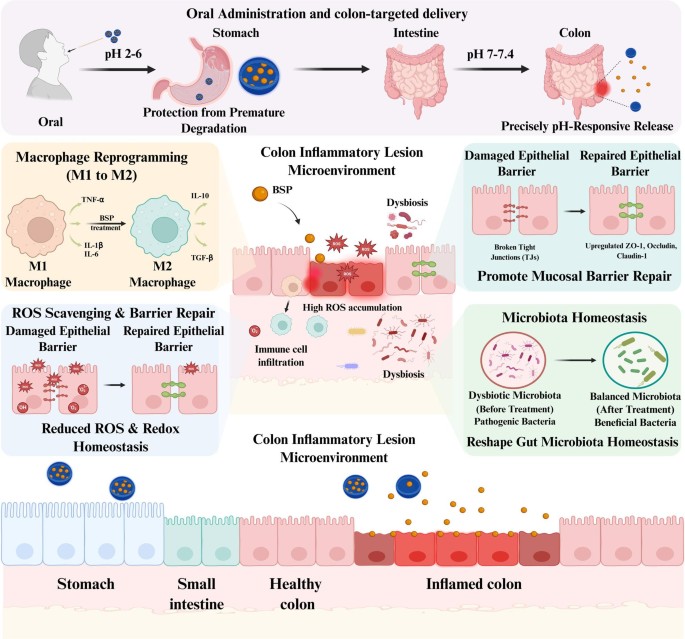
The study describes a new oral, colon‑targeted delivery system that improved outcomes in a mouse model of ulcerative colitis and shifted immune and microbiome markers—research that could inform future therapies focused...
The study suggests a plant-derived AHR-activating mechanism that reduced inflammation and repaired the intestinal barrier in preclinical ulcerative colitis models, a pathway that could be relevant to future therapies or...