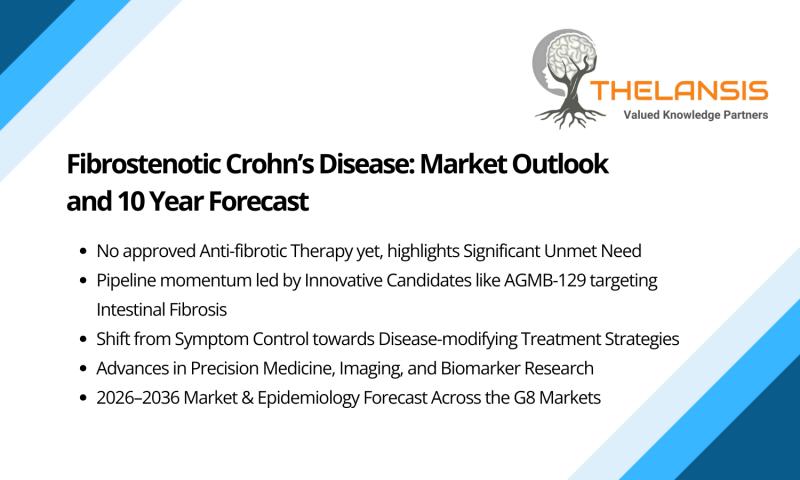
People with Crohn's disease often develop intestinal fibrosis and strictures that current drugs don't reverse; a growing drug pipeline aiming at anti‑fibrotic therapies could change future treatment options.
The article signals industry interest and early clinical activity, which may lead to new trial opportunities and eventually new therapies.
Who Should Pay Attention
Patients with fibrostenotic or stricturing Crohn's disease, clinicians managing strictures, researchers and industry stakeholders tracking anti‑fibrotic drug development.
Study Snapshot
Story typePress release
Evidence typePhase 2 clinical trial
Source depthFull source text
What To Know
This is an industry market outlook summarizing the clinical and commercial landscape rather than reporting new clinical trial data in detail.
It emphasizes that anti‑fibrotic treatments are an active area of research, that precision imaging and biomarkers are priorities, and that current standard care focuses on controlling inflammation and using endoscopic or surgical approaches for strictures.
Keep In Mind
This is a commercial market outlook summarizing unmet needs, pipeline candidates, and market opportunities; it is not a clinical guideline or a primary clinical-trial report. Specific drug mentions reflect investigational programs noted in the report and should be followed up via original trial publications or regulatory sources for clinical details.
Source Details
Review the original publication for the complete reporting, methods, and context.
This Cure8 brief is based on source text from the linked article. Cure8 is informational only and is not a substitute for professional medical advice, diagnosis, or treatment.
This is an early positive interim report of a new oral drug (ALK5 inhibitor) aimed at fibrostenosing Crohn’s disease. Treatments that target intestinal strictures are an important area of research for people with...
This report describes an investigational drug that appears to reach its intestinal target and produced molecular changes in biopsies from people with fibrostenosing Crohn’s — a form that causes scarring and strictures.
Cure8 found this source from tmcnet.com, but the page could not be read reliably yet. It is tagged for Crohn's disease, Inflammatory bowel disease, and Stricture. Open the original article for the full details.