Intestinal fibrosis causes strictures that can lead to obstruction and often require surgery; current drugs mainly reduce inflammation and do not reliably prevent or reverse fibrosis. Advances in understanding fibrosis mechanisms could point to new targeted treatments that matter for long-term outcomes.
Who Should Pay Attention
Patients with Crohn’s disease or other IBD at risk for strictures, clinicians managing IBD, surgeons, and researchers studying fibrosis or drug development.
Study Snapshot
Story typeResearch paper
Evidence typeResearch paper
Source depthJournal abstract
What To Know
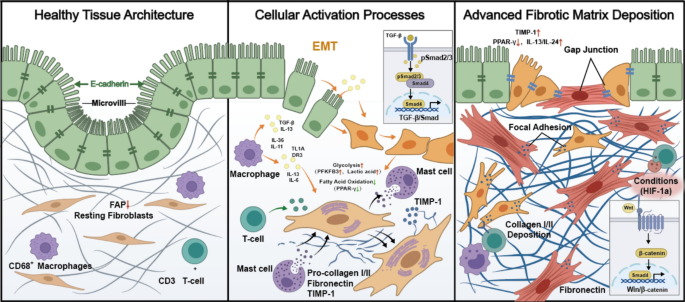
The paper summarizes cellular and molecular mechanisms driving intestinal fibrosis, highlighting fibroblast activation, epithelial–mesenchymal transition, and interactions with the immune microenvironment as central processes.
It emphasizes that current medical treatments mainly target inflammation rather than fibrosis itself, and that surgery relieves obstruction but does not prevent fibrotic progression or recurrence.
The authors outline that better mechanistic understanding could guide development of targeted anti-fibrotic therapies and help optimize clinical strategies; because this is a review, it synthesizes existing studies rather than presenting new trial results.
Keep In Mind
This source is a review article (abstract supplied) that synthesizes existing research rather than reporting new clinical trial results. Findings and therapeutic opportunities discussed are based on current evidence and remain subject to validation in clinical studies.
Source Details
Review the original publication for the complete reporting, methods, and context.
This Cure8 brief is based on source text from the linked article. Cure8 is informational only and is not a substitute for professional medical advice, diagnosis, or treatment.
Capsule endoscopy can be helpful for small-bowel assessment in Crohn’s disease but carries a risk of retention when strictures are present. Retained capsules may be asymptomatic yet still require surgery, so better...
Colorectal lymphoma in children can mimic IBD flares or cause surgical emergencies; recognizing this can prevent inappropriate escalation of immunosuppression and speed correct diagnosis and treatment.
The article outlines complications that can come from Crohn’s disease, many of which may need tests, medication, or surgery. Knowing these helps you recognize warning signs and talk with your care team about prevention...