Naunyn-Schmiedeberg's Archives of Pharmacology· via Crossref
Cure8 research brief
Isorhamnetin ameliorates active ulcerative colitis potentially involving the Nrf2-PTGS2 axis: an integrative study from clinical evidence mining to in vivo validation
This article suggests a naturally derived compound (isorhamnetin) identified from TCM may reduce inflammation in experimental ulcerative colitis and points to the Nrf2–PTGS2 pathway as a possible mechanism. That could guide future lab and clinical research toward new therapies for UC.
Who Should Pay Attention
Researchers studying drug discovery for IBD, clinicians interested in mechanisms of anti-inflammatory compounds, and patients/researchers curious about TCM-derived candidates for UC treatment.
Study Snapshot
Story typeResearch paper
Evidence typeResearch paper
Source depthJournal abstract
What To Know
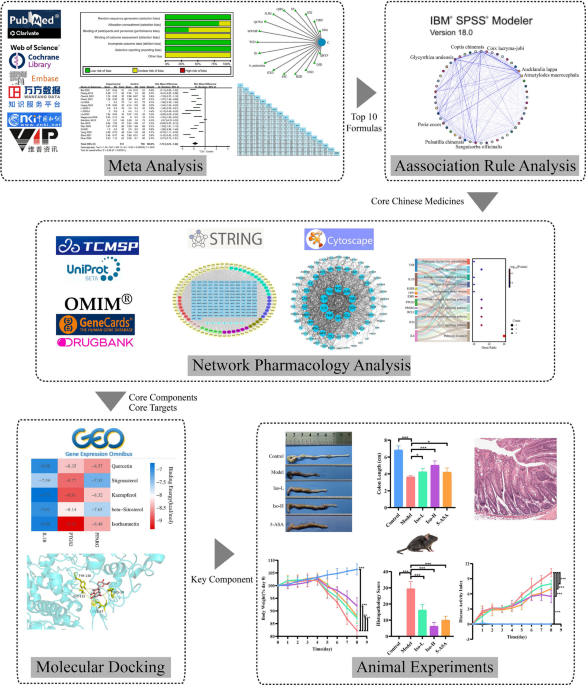
This paper reports a multi-part study exploring Traditional Chinese Medicine (TCM) for active ulcerative colitis (UC). The authors performed a meta-analysis of randomized controlled trials, used data-mining and network pharmacology to identify core herbs and candidate compounds, and then tested the top compound, isorhamnetin, in a mouse model of active UC.
In the meta-analysis (17 RCTs, ~1,598 patients) the authors report that TCM interventions were associated with improved outcomes for active UC (reported SMD and CI in the abstract).
From association-rule analysis they identified eight core herbs and used network pharmacology and molecular docking to predict targets; isorhamnetin showed predicted strong binding to PTGS2 and Nrf2.
The compound was then given to mice with induced UC and produced dose-dependent improvements in disease signs, pathology, and spleen index according to the abstract.
The paper frames isorhamnetin as a candidate for further mechanistic studies and possibly clinical investigation; however the study combines literature synthesis, in silico prediction, and animal validation rather than head-to-head clinical efficacy of pure isorhamnetin in people.
Keep In Mind
this work integrates meta-analysis, computational predictions, and mouse experiments. The animal results and docking predictions do not prove safety or efficacy in humans; the abstract indicates the need for further mechanistic and clinical investigation.
Source Details
Review the original publication for the complete reporting, methods, and context.
This Cure8 brief is based on source text from the linked article. Cure8 is informational only and is not a substitute for professional medical advice, diagnosis, or treatment.
If environmental microplastics contribute to gut dysbiosis and mucosal inflammation, this could help explain environmental triggers of ulcerative colitis and point toward prevention or microbiome-targeted interventions.
This study links an HLA gene (DRB1) to shared T cell receptor patterns in both Crohn’s disease and ulcerative colitis, suggesting common immune targets across IBD subtypes. That could help researchers identify antigens...
The study suggests a plant-derived AHR-activating mechanism that reduced inflammation and repaired the intestinal barrier in preclinical ulcerative colitis models, a pathway that could be relevant to future therapies or...