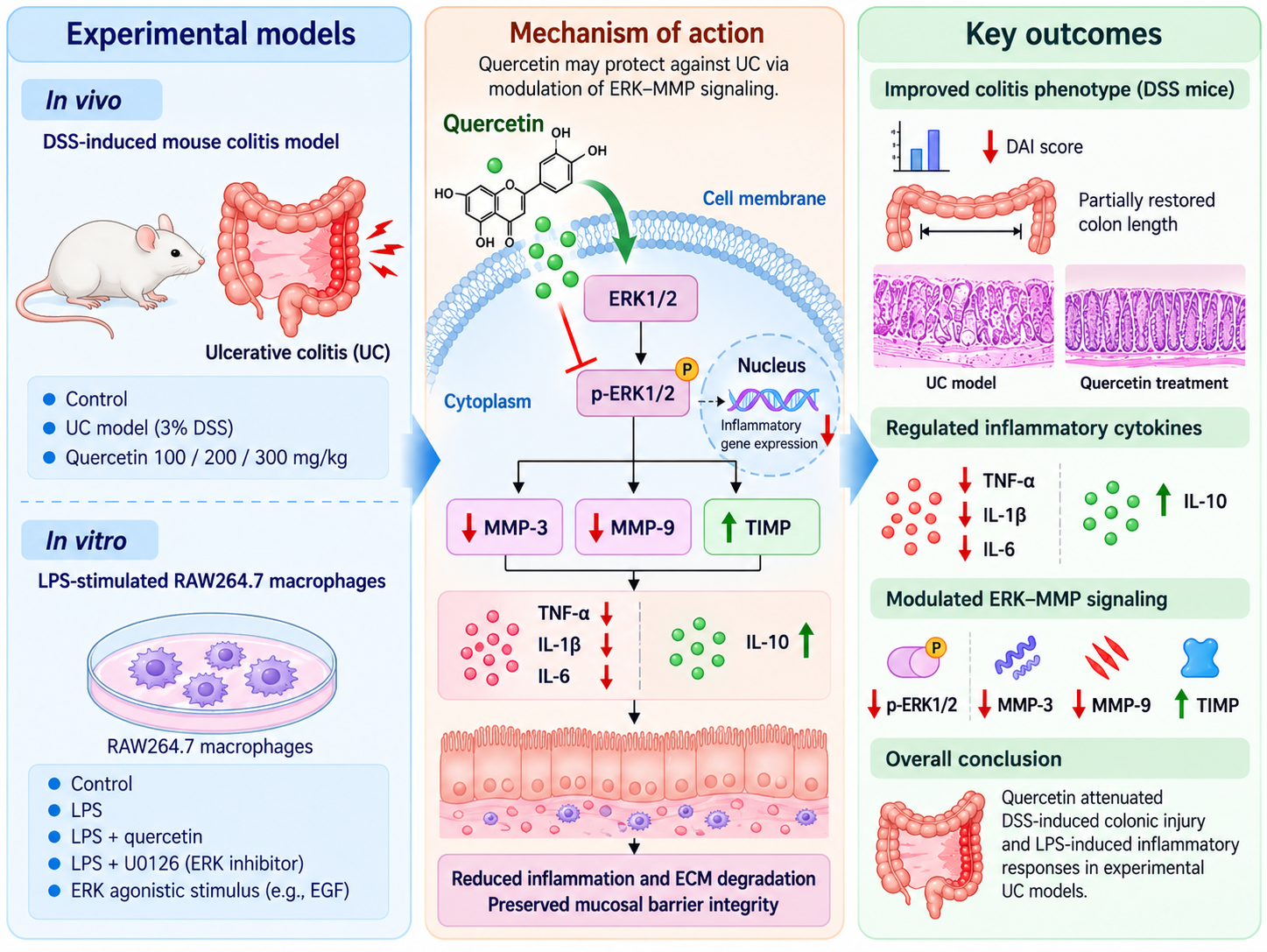
The study suggests quercetin can reduce inflammation and tissue damage markers in lab models of ulcerative colitis, pointing to ERK–MMP signaling as a possible mechanism. That could inform future preclinical research toward new therapies or adjuncts.
Who Should Pay Attention
Researchers studying IBD mechanisms or anti-inflammatory nutraceuticals, translational scientists planning preclinical-to-clinical work, and clinicians interested in emerging basic-science evidence (but not as guidance for patient treatment).
Study Snapshot
Story typeResearch paper
Evidence typeResearch paper
Source depthJournal abstract
What To Know
This is an exploratory preclinical study using DSS-treated mice and LPS-stimulated RAW264.7 cells, not a human trial. The authors tested multiple quercetin doses and measured colon morphology, cytokines, and ERK–MMP pathway molecules; higher doses showed greater effects in the models used.
The pathway link is associative: in vitro ERK inhibition produced directionally similar molecular changes, but the study did not include genetic rescue experiments, pharmacokinetic data, or human-relevant models to prove causality or clinical benefit.
Practical takeaways: the findings support further preclinical work (e.g., pathway-specific rescue experiments, PK studies, and human models) before considering clinical translation or recommending quercetin to patients.
Keep In Mind
This is an animal and cell-based study (exploratory, basic-science). Results are associative and not validated in humans; the authors explicitly call for pathway-specific rescue experiments, pharmacokinetic work, and human-relevant models before clinical claims can be made.
Source Details
Review the original publication for the complete reporting, methods, and context.
This Cure8 brief is based on source text from the linked article. Cure8 is informational only and is not a substitute for professional medical advice, diagnosis, or treatment.
The study suggests a new mechanism—blocking HSP90-mediated necroptosis of intestinal epithelial cells—that may reduce inflammation and tissue damage in ulcerative colitis, which could guide early drug-discovery efforts.
The work suggests that specific gut bacteria or their metabolic products (acetate, putrescine) can limit harmful E. coli expansion and reduce inflammation in a mouse model of colitis, which could inform future probiotic...
People with UC may care because the study identifies a compound and a signaling pathway that lowered inflammation and tissue injury in a commonly used mouse model of colitis, suggesting potential future therapeutic...