Validated patient-reported measures help track how IBD affects daily function and well-being. A Turkish IBD-Disk gives clinicians and researchers a standardized way to measure patient-perceived disease burden and monitor change over time.
Who Should Pay Attention
Adult patients with IBD (Turkish-speaking), gastroenterologists and IBD nurses, clinical researchers running IBD studies in Turkish populations, and centers doing routine patient-reported outcome monitoring.
Study Snapshot
Story typeResearch paper
Evidence typeResearch paper
Source depthJournal abstract
What To Know
This study reports the translation and validation of the IBD-Disk (a patient-reported visual measure of disease-related burden) into Turkish and evaluates its reliability and validity in a cohort of 202 IBD patients (114 Crohn’s, 88 UC) at a tertiary center.
The Turkish IBD-Disk showed high internal consistency and moderate test–retest reliability, and scores correlated moderately with clinical disease-activity indices. The authors also report responsiveness to clinical improvement over 6 months.
How this may matter to you If you are a patient in Turkey or a clinician working with Turkish-speaking patients, this tool can help capture patient-perceived burden of IBD in a standardized way.
The IBD-Disk is brief and patient-centered and may complement clinical scores like the Harvey–Bradshaw Index or partial Mayo when tracking symptoms and functional impact. Practical note This report is a psychometric validation (translation, reliability, validity, responsiveness) rather than a treatment study.
It supports the Turkish IBD-Disk as a research and clinical monitoring instrument but does not address how use of the tool changes clinical outcomes.
Keep In Mind
This record is a peer-reviewed journal abstract reporting psychometric validation using standard methods (translation, test–retest, internal consistency, correlation with clinical indices) in a single tertiary-center cohort. It does not evaluate whether using the IBD-Disk improves clinical decision-making or long-term outcomes.
Source Details
Review the original publication for the complete reporting, methods, and context.
This Cure8 brief is based on source text from the linked article. Cure8 is informational only and is not a substitute for professional medical advice, diagnosis, or treatment.
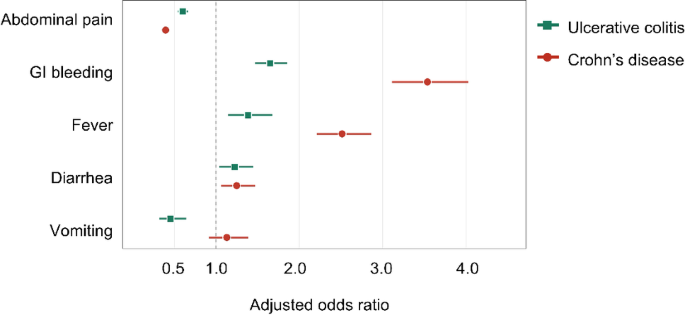
The study suggests ED presentation symptoms predict admission differently in UC versus CD, which could affect triage and short-term risk assessment for IBD patients. Knowing which symptoms are stronger predictors by...
A validated Spanish IBD-Disk gives Spanish-speaking patients and clinicians a brief, validated tool to measure disability and global health in IBD, supporting consistent monitoring and research across Spanish-speaking...
The study suggests most adults with chronic diarrhea in this tertiary setting had organic/inflammatory disease and identifies accessible clinical and lab predictors that could help prioritize endoscopic evaluation.