bioRxiv
Cure8 research brief
Cure8 research brief
Researchers identified TLR7 activation by the drug vesatolimod as reducing inflammation in a mouse model of colitis and shifting immune cells toward a regulatory profile. This suggests a new immune pathway that could be explored for IBD treatments but is still far from human testing.
Researchers studying immune pathways or drug discovery for IBD; clinicians following preclinical therapeutic developments; translational scientists interested in TLR biology.
This preprint reports mouse-model results testing the TLR7 agonist GS-9620 (vesatolimod) in acute DSS colitis. Treated mice showed less weight loss, lower disease activity scores, and reduced colon shortening.
Spleen immunophenotyping suggested fewer Th17/Tr17 cells and more regulatory T cells, which the authors interpret as a systemic shift toward a regulatory immune phenotype. The study is preclinical (mouse), uses an acute chemical colitis model, and focuses on mechanism and target identification rather than clinical outcomes.
Because this is an abstract from a preprint, details on experimental design, dosing, timing, and reproducibility are limited here. The findings suggest TLR7 activation could modulate immune responses relevant to IBD, but they do not demonstrate safety or efficacy in humans.
Further work is needed to test chronic models, gut-specific delivery routes, dose–response, and causal mechanisms before clinical translation.
If you follow IBD research, this is an early-stage preclinical study that highlights TLR7 as a potential target and vesatolimod as a probe compound; it does not change clinical care or provide evidence for use in patients.
This is a bioRxiv preprint reporting results in an acute DSS-induced mouse colitis model. Preclinical animal findings often do not translate directly to humans; the abstract provides limited methodological detail. The authors note the need for direct tests of causality, different administration routes, and relevance to chronic disease. Summary confidence: medium.
Review the original publication for the complete reporting, methods, and context.
This Cure8 brief is based on source text from the linked article. Cure8 is informational only and is not a substitute for professional medical advice, diagnosis, or treatment.
This study identifies NR1D1 activation by the experimental drug SR9009 as a potential way to reduce inflammation and improve colon pathology in a mouse model of obesity-associated ulcerative colitis.
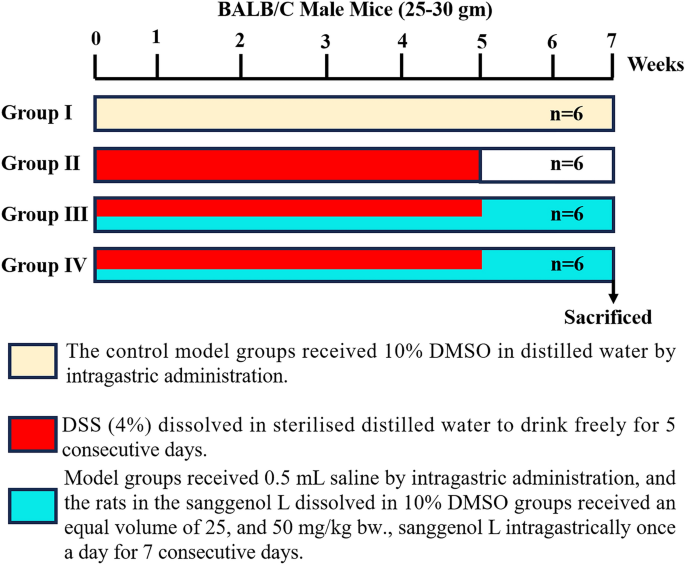
Researchers exploring new anti-inflammatory or antioxidant compounds for ulcerative colitis may find sanggenol L’s effects on Nrf2/HO-1 and TLR4/p65 signalling of interest. Patients should note this is early-stage,...
Preclinical work identifies a natural-product mixture that reduced inflammation, improved gut barrier markers, and changed the microbiome in a mouse model of ulcerative colitis. This could be an early step toward new...