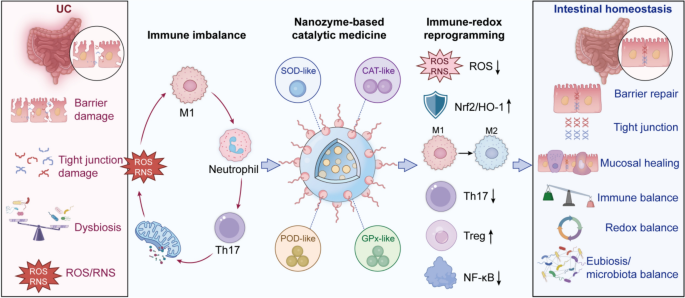
The review describes a novel preclinical approach—catalytic nanozymes—that aims to reduce oxidative stress and re-balance immune responses in ulcerative colitis, which could eventually lead to new treatments for patients who don’t respond to current therapies.
Who Should Pay Attention
Researchers in nanomedicine and IBD, translational scientists, clinicians following emerging therapies, and patients interested in future UC treatment options.
Study Snapshot
Story typeResearch paper
Evidence typeResearch paper
Source depthMetadata only
What To Know
This is an open-access review article describing nanozymes—engineered nanomaterials with enzyme-like catalytic activities—as an emerging preclinical therapeutic strategy for ulcerative colitis (UC).
The authors summarize how nanozymes can scavenge reactive oxygen/nitrogen species, modulate immune cells (macrophages, neutrophils, dendritic cells, T cells), and support mucosal healing in experimental colitis models, plus engineering advances for targeting and delivery.
The review focuses on preclinical (animal and mechanistic) evidence rather than clinical trials. It highlights catalytic antioxidant functions (SOD-, catalase-, peroxidase-, and glutathione peroxidase–like activities), immune–redox crosstalk, and strategies to improve colonic delivery and specificity.
The paper notes translational challenges including long-term safety and efficacy validation needed before clinical use.
Keep In Mind
Findings are drawn from preclinical studies (mechanistic and animal models); clinical translation requires further validation of long-term safety and efficacy.
Source Details
Review the original publication for the complete reporting, methods, and context.
This Cure8 brief is based on source text from the linked article. Cure8 is informational only and is not a substitute for professional medical advice, diagnosis, or treatment.
The study reports anti-inflammatory and antioxidant effects of a new andrographolide formulation in a macrophage model relevant to ulcerative colitis, highlighting a potential early-stage therapeutic lead that may...
Researchers report links between copper-driven cell death pathways and IBD biology; identifying cuproptosis-related biomarkers or drugs could open new diagnostic or therapeutic avenues for people with Crohn's disease or...
The study introduces a colon-targeted EGCG delivery system that reduced inflammation and improved microbial and metabolic markers in a mouse model of UC, suggesting a potential new therapeutic approach worth further...