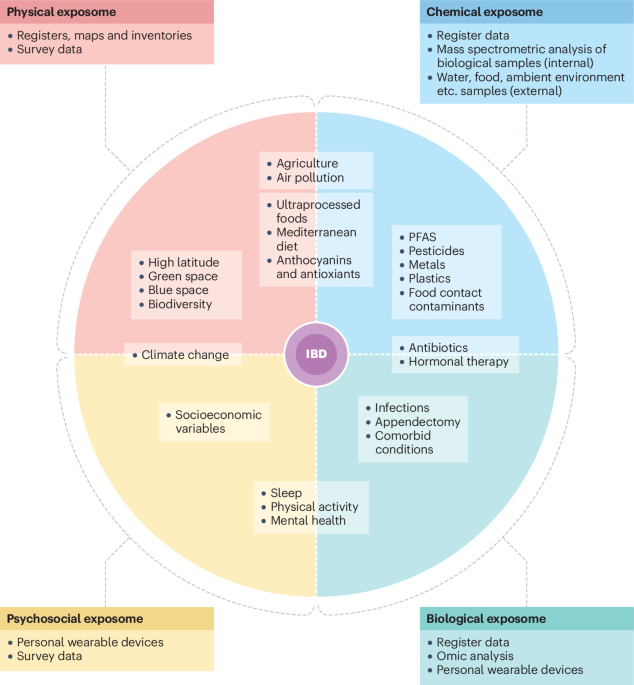
The exposome perspective emphasizes that many non-genetic, potentially modifiable environmental factors likely influence IBD risk. Understanding these factors could help guide prevention research and public-health strategies that reduce new cases of Crohn's disease and ulcerative colitis.
Who Should Pay Attention
Researchers studying IBD causes and prevention, clinicians interested in population and preventive health approaches, and patients or caregivers curious about environmental contributors to IBD risk.
Study Snapshot
Story typeResearch paper
Evidence typeResearch paper
Source depthMetadata only
What To Know
The paper synthesizes existing epidemiology and mechanistic literature to argue that non-genetic exposures contribute substantially to IBD risk and that integrating exposome data with genomics and multiomics can clarify causal pathways.
It highlights examples from population cohorts and meta-analyses (early-life environment, residential green space, urban versus rural exposure) and points to emerging methods in exposomics and high-resolution mass spectrometry for measuring chemical exposures.
The authors position prevention at two levels: primary prevention (reducing modifiable exposures in populations) and primordial prevention (addressing upstream social and environmental determinants). They discuss challenges including exposure measurement, complexity of interacting factors, and the need for longitudinal and mechanistic studies.
The review is a synthesis rather than a new trial or guideline; it summarizes the current evidence base and recommends research directions rather than providing clinical practice prescriptions.
Keep In Mind
This is a narrative review in a high-quality journal that synthesizes existing studies and methods rather than reporting new experimental results. Exposome research is complex and still developing; many associations are observational and require further longitudinal and mechanistic confirmation.
Source Details
Review the original publication for the complete reporting, methods, and context.
This Cure8 brief is based on source text from the linked article. Cure8 is informational only and is not a substitute for professional medical advice, diagnosis, or treatment.
The review highlights how microbial metabolites, epigenetic regulation, and mitochondrial metabolism interact to shape inflammation and barrier function in IBD. Understanding these links could help identify new...
The study synthesizes many stool metagenomes to find consistent microbial species, functional pathways, and strain-level differences linked to IBD and to distinctions between Crohn’s disease and ulcerative...