United European gastroenterology journal
Cure8 research brief
Cure8 research brief
The study connects a bothersome UC symptom (bowel urgency) to intestinal ultrasound signs of transmural inflammation, suggesting ultrasound might help explain and track symptom-related inflammation without relying solely on endoscopy.
Patients with ulcerative colitis who have bowel urgency; gastroenterologists, sonographers, and researchers interested in noninvasive monitoring and symptom pathophysiology.
This single-centre prospective study enrolled 59 ulcerative colitis patients undergoing colonoscopy and compared those reporting bowel urgency with those who did not.
Patients with urgency had higher C‑reactive protein, worse endoscopic scores, greater bowel wall thickness in the descending colon, sigmoid colon, and rectum, and increased colour Doppler signal in the sigmoid and rectum.
Notably, thicker sigmoid submucosa and muscularis propria were associated with urgency, suggesting transmural involvement may contribute to the symptom. The study used transabdominal and transperineal ultrasound alongside colonoscopy and biomarker measurement (CRP). It was registered (UMIN000050099) and reports associations rather than proving causation.
This report is an abstract-level summary from a single-centre prospective study with 59 patients; results are associative and need confirmation in larger studies before clinical practice changes.
Review the original publication for the complete reporting, methods, and context.
This Cure8 brief is based on source text from the linked article. Cure8 is informational only and is not a substitute for professional medical advice, diagnosis, or treatment.
The study will test whether routine point‑of‑care intestinal ultrasound changes clinical decisions compared with standard monitoring, which could make monitoring less invasive and more responsive if effective.
People with IBD who have no or few symptoms but still have moderate–severe inflammation on endoscopy face uncertainty about whether to switch therapies to aim for endoscopic remission.
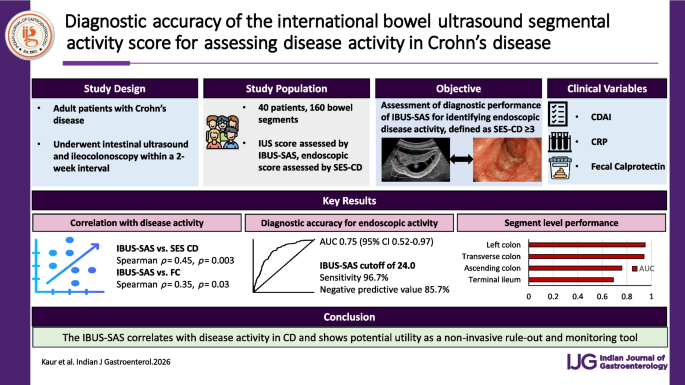
Standardized intestinal ultrasound scoring could help non-invasively monitor Crohn’s disease activity and reduce reliance on colonoscopy for some assessments. A high-sensitivity IUS score may be useful to rule out...