
Cure8 research brief
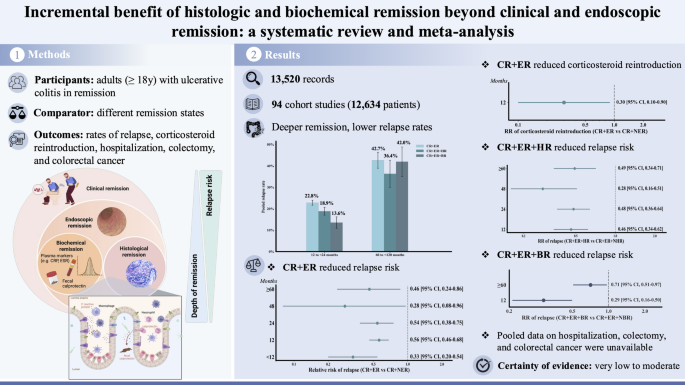
Achieving histologic or biochemical remission in addition to clinical and endoscopic remission was associated with substantially lower relapse risk in ulcerative colitis across multiple follow-up intervals, suggesting deeper remission measures may help predict and optimize long-term control.
Clinicians treating UC, researchers studying treat-to-target strategies and biomarkers, and patients interested in remission targets and relapse risk.
The paper synthesizes data from 94 studies (about 12,600 patients) and used GRADE to assess certainty.
Overall, endoscopic remission reduced relapse risk compared with non-endoscopic remission, and adding histologic remission or biochemical remission to clinical+endoscopic remission provided additional reductions in relapse risk across multiple follow-up intervals. Certainty of evidence varied by outcome and timepoint.
This is a systematic review and meta-analysis of observational cohort studies with variable certainty (GRADE) across outcomes; findings suggest associations but do not prove that treating to histologic or biomarker targets will necessarily change outcomes without prospective trial evidence.
Review the original publication for the complete reporting, methods, and context.
Funding disclosed by the source: Health@InnoHK Initiative Fund from the Hong Kong SAR Government, award ITC RC/IHK/4/7; Vincent and Lily Woo Foundation
This Cure8 brief is based on source text from the linked article. Cure8 is informational only and is not a substitute for professional medical advice, diagnosis, or treatment.