Gels
Cure8 research brief
Cure8 research brief
A targeted, pH-sensitive colon delivery system could improve effectiveness and reduce systemic side effects of drugs used for UC by releasing medication in the colon and protecting it from stomach degradation. For people with UC, better local delivery might mean improved symptom control with lower systemic exposure.
Researchers developing drug-delivery systems, pharmaceutical formulators, translational IBD researchers, and clinicians interested in future colon-targeted therapies.
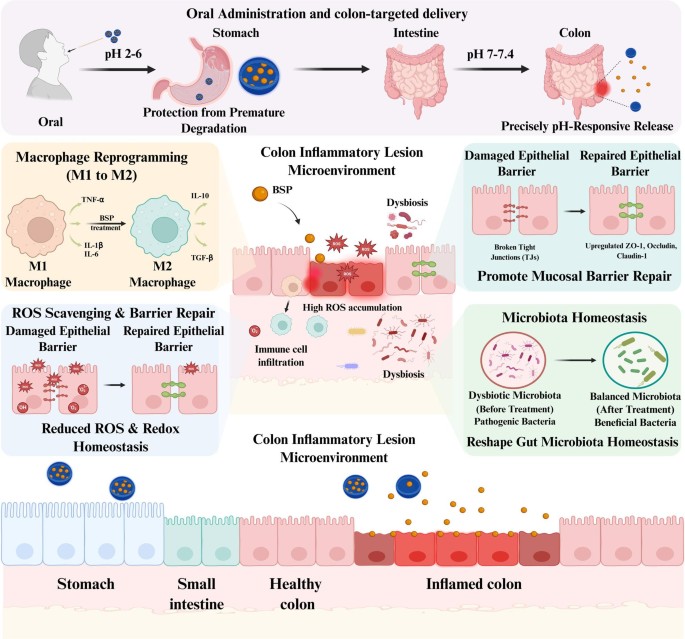
Researchers created alginate/CMCS core–shell hydrogel microcapsules loaded with olsalazine sodium that are pH-responsive: they resist release in acidic conditions and release drug more rapidly at colonic pH.
The paper reports formulation optimization (encapsulation efficiency ~59%, loading ~21%) and degradation/release testing showing protection in simulated gastric fluid and release at pH 7.4.
In a mouse model of ulcerative colitis the microcapsules produced greater localization to inflamed tissue and were associated with reduced NF-κB p65 levels and less histologic damage compared with free drug, suggesting improved local efficacy and reduced systemic exposure in this preclinical model.
This is preclinical, formulation-focused research rather than a clinical trial; findings in mice do not directly translate to patient outcomes. Additional studies (safety/toxicology, dose-ranging, and human clinical trials) would be required before clinical use.
This report describes preclinical (mouse) experiments and in vitro formulation testing; it does not provide human safety or efficacy data. The article focuses on an encapsulation approach using olsalazine sodium; translation to clinical practice would require multiple further development steps.
Review the original publication for the complete reporting, methods, and context.
Funding disclosed by the source: National Natural Science Foundation of China, award 22104046; award 22104046; Gansu Province Major Special Projects Program, award 26ZDFA003; Open Fund Project of Northwest Minzu University, award 31920260052; award 31920260052; Discipline Construction Fund of Northwest Minzu University, award 31920250002; award 31920250002
This Cure8 brief is based on source text from the linked article. Cure8 is informational only and is not a substitute for professional medical advice, diagnosis, or treatment.
The study describes a new oral, colon‑targeted delivery system that improved outcomes in a mouse model of ulcerative colitis and shifted immune and microbiome markers—research that could inform future therapies focused...
This study describes a new formulation of baicalein that improved drug solubility and oral absorption and showed benefit in a mouse model of ulcerative colitis—early-stage research that could inform future...
The study presents a new oral NRF2 activator that reduced inflammation and tissue injury in a mouse model of ulcerative colitis, suggesting a potential novel therapeutic approach.