The paper maps distinct stromal cell states tied to inflamed versus fibrotic tissue niches in Crohn’s disease and shows that these states have different chromatin configurations and drug-modifiable properties — pointing to stromal epigenetics as a possible new therapeutic avenue for fibrosis and treatment-refractory disease.
Who Should Pay Attention
Researchers (single-cell, epigenetics, IBD), translational clinicians, patients with fibrostenotic or refractory Crohn’s disease, drug-discovery teams
Study Snapshot
Story typeResearch paper
Evidence typeEarly laboratory research
Source depthFull source text
What To Know
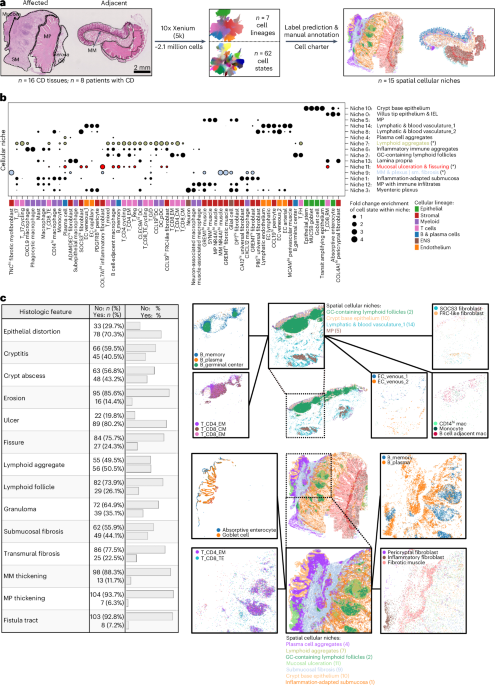
The researchers applied spatial transcriptomics (Xenium), single-cell ATAC-seq and in vitro assays to surgical ileal tissue from patients with longstanding, therapy-refractory Crohn’s disease.
They identified nearby but distinct pathological niches—ulcer-associated inflammatory fibroblasts (IFs) vs contractile stromal (CS) cells in fibrotic areas—with distinct open chromatin and transcriptional programs.
IFs are associated with high local cytokine signaling and neutrophil-rich ulcers and appear stable after cytokine exposure, whereas certain epigenetic-modifying compounds destabilized or shifted IFs toward a contractile phenotype in culture. This report is focused on mechanistic, preclinical findings rather than clinical outcomes.
It suggests stromal epigenetic state as a potential target for future therapies aimed at fibrosis or treatment-refractory inflammation in Crohn’s disease, but it does not provide clinical trial data or treatment recommendations.
Keep In Mind
Mechanistic study using spatial single-cell transcriptomics, single-cell ATAC-seq and in vitro assays on surgical specimens from patients with longstanding, refractory Crohn’s disease. Results are preclinical and do not demonstrate clinical safety or efficacy of epigenetic modifiers.
Source Details
Review the original publication for the complete reporting, methods, and context.
This Cure8 brief is based on source text from the linked article. Cure8 is informational only and is not a substitute for professional medical advice, diagnosis, or treatment.
The study maps cell types and signals linked to submucosal scarring in Crohn's disease, a complication without drug treatments that often requires surgery. Understanding these mechanisms could point to future therapeutic...
If correct, the paper points to a previously underappreciated immune cell (GzmK+ tissue-resident CD8+ T cells) as a potential driver of Crohn’s inflammation — which could lead to new biomarkers or therapies that work...
AI models that combine CTE/MRE imaging with clinical and molecular data could improve objective classification of small-bowel Crohn's disease and help predict which patients are likely to respond to medical therapy...