Research topics

Single-cell sequencing

Single-cell sequencing articles covering cell atlases, RNA sequencing, gene activity, and high-resolution IBD research methods.

24 articles

Single-cell transcriptomic analysis reveals that Trametes robiniophila Murr. (Huaier) granules protect against ulcerative colitis by targeting macrophage-associated cGAS-STING signaling.
Journal of ethnopharmacology

Single-cell transcriptomic analysis reveals that Trametes robiniophila Murr. (Huaier) granules protect against ulcerative colitis by targeting macrophage-associated cGAS-STING signaling.

The study describes a mechanism by which Huaier granules reduced colitis-related inflammation in mice and cell models by targeting macrophage cGAS–STING signaling and altering the gut microbiome—information that could...

Read Summary
A Centimeter-Scale, Peristaltic Human Intestinal Organoid with Integrated Neuro-Immune-Vascular Systems Recapitulates Enteritis and Orthotopic Colorectal Cancer
Europe PMC

A Centimeter-Scale, Peristaltic Human Intestinal Organoid with Integrated Neuro-Immune-Vascular Systems Recapitulates Enteritis and Orthotopic Colorectal Cancer

This model could improve how researchers study IBD inflammation and early colorectal cancer in a human-derived, multicellular system that reproduces neuromuscular function and immune responses. That may speed preclinical...

Read Summary
Single-cell and spatial transcriptomics across populations with perianal fistulizing Crohn's disease shows pro-inflammatory CD4+ macrophage involvement in disease progression.
Cellular and molecular gastroenterology and hepatology

Single-cell and spatial transcriptomics across populations with perianal fistulizing Crohn's disease shows pro-inflammatory CD4+ macrophage involvement in disease progression.

The study points to a specific immune cell type (pro-inflammatory CD4+ macrophages) and altered cellular interactions in rectal tissue that are linked to perianal fistulizing Crohn's disease, which may help explain...

Read Summary
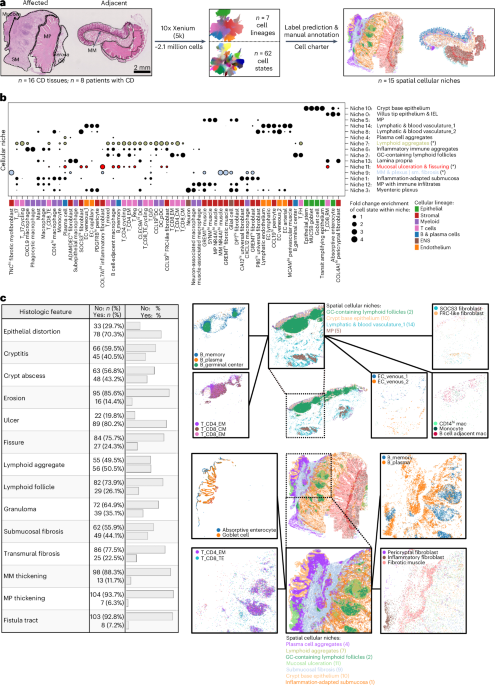
Epigenetic modulation of stromal cell states underpins pathological tissue niches in Crohn's disease
nature.com

Epigenetic modulation of stromal cell states underpins pathological tissue niches in Crohn's disease

The paper maps distinct stromal cell states tied to inflamed versus fibrotic tissue niches in Crohn’s disease and shows that these states have different chromatin configurations and drug-modifiable properties — pointing...

Read Summary
Integrated Transcriptomic and Machine-Learning Analyses Identify Shared Na+ Overload-Related Gene Signatures in Inflammatory Bowel Disease and Ankylosing Spondylitis
Genes

Integrated Transcriptomic and Machine-Learning Analyses Identify Shared Na+ Overload-Related Gene Signatures in Inflammatory Bowel Disease and Ankylosing Spondylitis

The study links shared gene-expression patterns between IBD and ankylosing spondylitis and highlights STAT3 as a potential shared biomarker or therapeutic target, which could be relevant for understanding overlapping...

Read Summary
The causal role of plasma protein ratios in ulcerative colitis: insights from mendelian randomization and single-cell sequencing.
Open medicine (Warsaw, Poland)

The causal role of plasma protein ratios in ulcerative colitis: insights from mendelian randomization and single-cell sequencing.

Researchers used genetics plus single-cell sequencing and ELISA to prioritize plasma protein ratios that may causally relate to ulcerative colitis. If validated in larger studies, such biomarkers could help with...

Read Summary
Astrocytic HSP90AA1 Upregulation and Altered Synaptic Signaling in Parkinson’s Disease: Transcriptomic Screening and In Vivo Validation
International Journal of Molecular Sciences

Astrocytic HSP90AA1 Upregulation and Altered Synaptic Signaling in Parkinson’s Disease: Transcriptomic Screening and In Vivo Validation

This study links blood gene signatures shared between Parkinson’s disease and intestinal inflammation to astrocyte-associated molecular changes in the brain, identifying HSP90AA1 as a candidate stress-responsive hub.

Read Summary
T cell immunity to SARS-CoV-2 vaccination in inflammatory bowel disease patients treated with anti-cytokine biologics.
Journal of immunology (Baltimore, Md. : 1950)

T cell immunity to SARS-CoV-2 vaccination in inflammatory bowel disease patients treated with anti-cytokine biologics.

People with IBD and those on commonly used biologics may have different early T cell responses and faster waning after SARS-CoV-2 vaccination, which could affect timing or interpretation of immune monitoring and booster...

Read Summary
Clostridioides difficile-Driven Expansion of IL1B+ Monocytes Amplifies Neutrophil Recruitment in Ulcerative Colitis 2258811
The Journal of Immunology

Clostridioides difficile-Driven Expansion of IL1B+ Monocytes Amplifies Neutrophil Recruitment in Ulcerative Colitis 2258811

The study suggests C. difficile colonization may expand IL1B+ monocytes that recruit neutrophils and amplify inflammation in ulcerative colitis, a pathway that could help explain pathogen-associated flares.

Read Summary
Macrophage-Centered Integration of Single-Cell and Bulk Transcriptomic Data Identifies CCL3, CCL4, and JUNB as Inflammatory Regulatory Signatures in Ulcerative Colitis
Genes

Macrophage-Centered Integration of Single-Cell and Bulk Transcriptomic Data Identifies CCL3, CCL4, and JUNB as Inflammatory Regulatory Signatures in Ulcerative Colitis

Identifies macrophage-linked genes (CCL3, CCL4, JUNB) that are strongly upregulated in ulcerative colitis and may help explain immune-cell remodeling in the colon. These genes could serve as biomarkers or starting points...

Read Summary
Contribution of the appendix to ulcerative colitis by supplying pathogenic immunoglobulin G-producing cells
World Journal of Gastroenterology

Contribution of the appendix to ulcerative colitis by supplying pathogenic immunoglobulin G-producing cells

If the appendix is a significant source of harmful IgG antibodies in ulcerative colitis, that could help explain why appendectomy sometimes reduces UC risk or severity and might influence future therapies targeting...

Read Summary
Integrative Bioinformatics Analysis of Single Cell RNA-Sequencing Data Reveals Key Regulatory Genes and Therapeutic Targets in Inflammatory Bowel Disease
Europe PMC

Integrative Bioinformatics Analysis of Single Cell RNA-Sequencing Data Reveals Key Regulatory Genes and Therapeutic Targets in Inflammatory Bowel Disease

The study uses single-cell RNA sequencing to pinpoint genes and regulatory networks that might help explain IBD biology and suggest new biomarkers or repurposed drugs. That information could guide future research toward...

Read Summary
Potential role of PPARGC1A in linking ulcerative colitis to colorectal cancer: a novel prognostic biomarker and therapeutic target.
Translational cancer research

Potential role of PPARGC1A in linking ulcerative colitis to colorectal cancer: a novel prognostic biomarker and therapeutic target.

People with long-standing ulcerative colitis face an increased risk of colorectal cancer; this study highlights PPARGC1A as a gene that may be downregulated early in that progression, which could eventually help identify...

Read Summary
Multi-omics Mendelian randomization and experimental validation identify PRKAB1 as a regulator of phosphatidylcholine metabolism in IBD.
Naunyn-Schmiedeberg's archives of pharmacology

Multi-omics Mendelian randomization and experimental validation identify PRKAB1 as a regulator of phosphatidylcholine metabolism in IBD.

Phosphatidylcholines are implicated in IBD biology; identifying a gene that regulates PC metabolism could point to new mechanistic targets. If PRKAB1 modulates epithelial lipid metabolism relevant to inflammation, it may...

Read Summary