This study helps move beyond assigning GWAS risk variants to the nearest gene by mapping 3D promoter contacts in gut-enriched ILC3s, so it uncovers new candidate genes and pathways that could explain Crohn’s and other autoimmune disease risk.
For people with IBD, this could point researchers toward cell types and mechanisms worth studying for future diagnostics or treatments.
Who Should Pay Attention
Researchers studying IBD genetics, immunology, and gene regulation; clinicians interested in IBD pathogenesis; patients and advocates following research into Crohn’s disease mechanisms.
Study Snapshot
Story typeResearch paper
Evidence typeEarly laboratory research
Source depthFull source text
What To Know
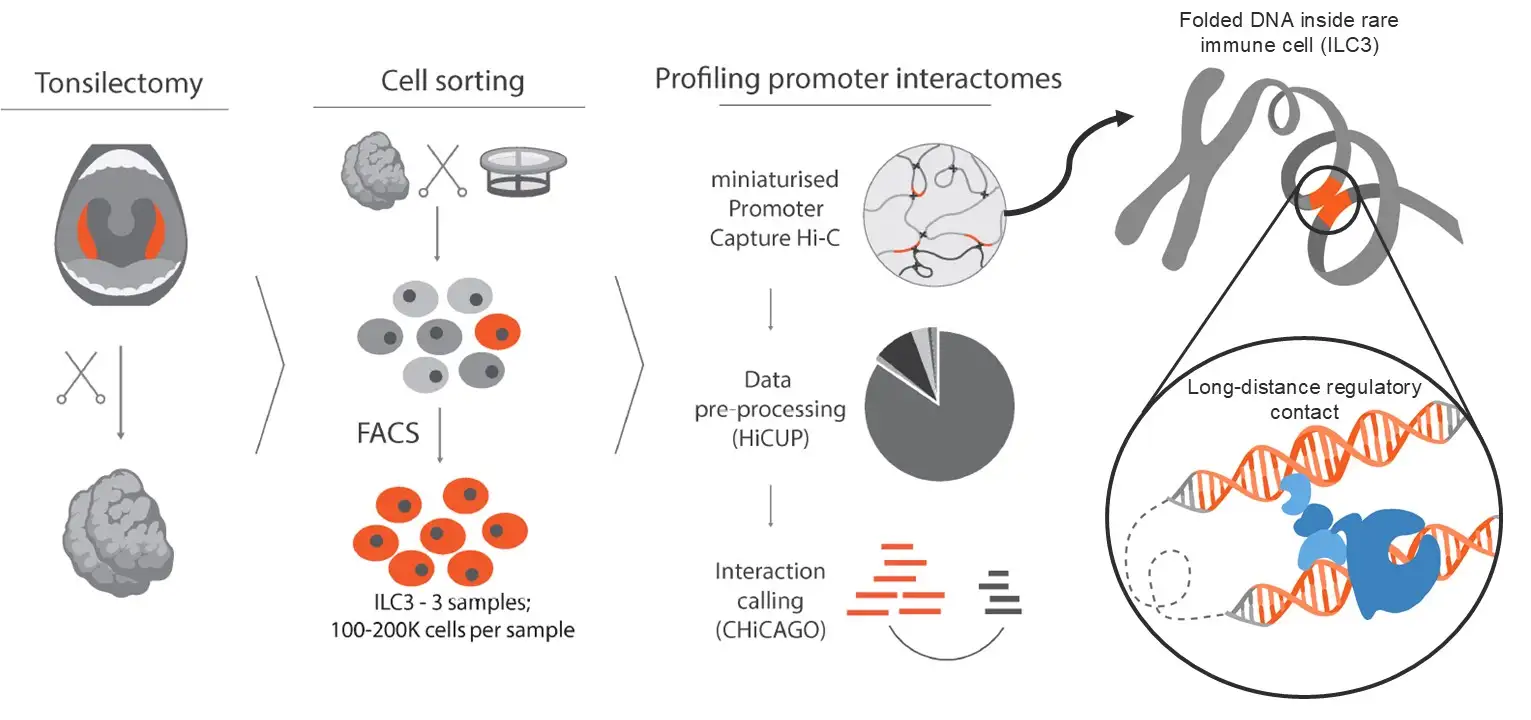
This work maps long-range promoter interactions in rare, tissue-resident type 3 innate lymphoid cells (ILC3s) using a low-input high-resolution method and connects noncoding autoimmune risk variants to likely target genes in those cells.
That revealed many candidate genes for Crohn’s disease risk that would not be assigned by proximity alone and highlights cell-type–specific 3D genome folding as important for interpreting GWAS signals.
The study provides experimental follow-up for one unexpected gene (CLN3) suggesting it can influence ILC3 inflammatory activity in cell models, but the authors state these results do not establish CLN3 as a causal Crohn’s gene.
The primary contribution is a methodological and mapping resource linking risk variants to genes in ILC3s that can guide future mechanistic work.
Next steps noted by the authors include clarifying how CLN3 affects immune function in ILC3s, applying the low-input promoter-capture approach to other rare immune cell types, and further functional validation of candidate genes and pathways.
Keep In Mind
These results are based on genomic mapping and cell-model follow-up; they do not prove causality in patients. The paper is a resource for hypothesis generation and prioritization of genes/pathways for further functional and clinical study.
Source Details
Review the original publication for the complete reporting, methods, and context.
Early laboratory researchArticle type assigned from Cure8 classification; confirm details in the original source.
Publicationgenengnews.com
Indexed viaGoogle News
Source typeWeb article
PublishedAug 4, 2026, 3:02 PM
Content availableFull source text
This Cure8 brief is based on source text from the linked article. Cure8 is informational only and is not a substitute for professional medical advice, diagnosis, or treatment.
ILC3s are rare but important for gut immunity; linking Crohn’s disease genetic risk to the genes they regulate helps move from statistical association toward biological mechanisms that could explain disease pathways.
Mapping 3D genome contacts in rare gut immune cells connects Crohn’s disease genetic risk variants to specific genes and pathways, which can clarify disease mechanisms and guide future drug-target research. The study...
The work helps bridge genetic association signals and the specific immune cells in the intestine where they may act, offering new candidate genes and a method that can probe rare cell types important to IBD biology.