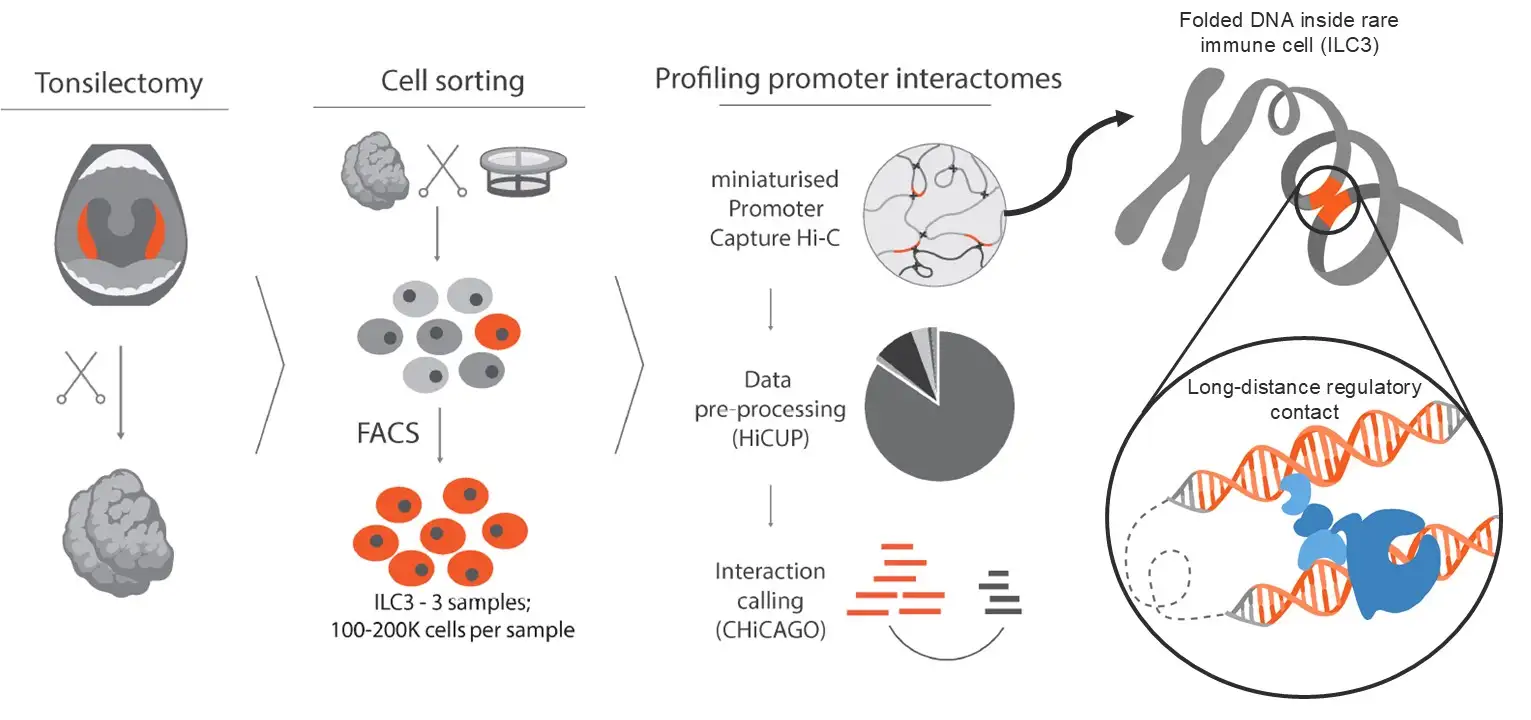
ILC3s are rare but important for gut immunity; linking Crohn’s disease genetic risk to the genes they regulate helps move from statistical association toward biological mechanisms that could explain disease pathways.
Who Should Pay Attention
Researchers studying IBD genetics and immune cell regulation, clinicians interested in emerging genetic mechanisms of Crohn’s disease, and patients or advocates curious about how genetic studies can reveal new disease pathways.
Study Snapshot
Story typeResearch paper
Evidence typeEarly laboratory research
Source depthFull source text
What To Know
The researchers adapted a promoter capture Hi‑C approach optimized for small numbers of cells so they could measure 3D DNA promoter–regulatory element contacts in human ILC3s. They combined those maps with GWAS data to prioritize over 100 candidate genes for Crohn’s disease risk acting in ILC3s.
Follow-up experiments in mouse models examined one highlighted gene, Cln3: its expression fell after ILC3 activation, and experimentally increasing Cln3 reduced inflammatory gene activity and cytokine production.
The authors do not claim CLN3 is a proven causal IBD gene; rather, the data raise new hypotheses about immune roles for genes previously linked to rare neurodevelopmental disease. Looking ahead, the paper provides a toolset to study 3D gene regulation in other rare immune cell types and to move from genetic association toward mechanistic insight.
Keep In Mind
This is a basic-science study using promoter capture Hi‑C and GWAS integration; reported functional tests were performed in mouse models and do not establish causality in human IBD. The work opens hypotheses for further validation rather than providing clinical findings or treatment implications.
Source Details
Review the original publication for the complete reporting, methods, and context.
Early laboratory researchArticle type assigned from Cure8 classification; confirm details in the original source.
Publicationscienceblog.cincinnatichildrens.org
AuthorsScience Blog
Indexed viaGoogle News
Source typeWeb article
PublishedAug 4, 2026, 12:56 PM
Content availableFull source text
This Cure8 brief is based on source text from the linked article. Cure8 is informational only and is not a substitute for professional medical advice, diagnosis, or treatment.
The work helps bridge genetic association signals and the specific immune cells in the intestine where they may act, offering new candidate genes and a method that can probe rare cell types important to IBD biology.
This study helps move beyond assigning GWAS risk variants to the nearest gene by mapping 3D promoter contacts in gut-enriched ILC3s, so it uncovers new candidate genes and pathways that could explain Crohn’s and other...
Mapping 3D genome contacts in rare gut immune cells connects Crohn’s disease genetic risk variants to specific genes and pathways, which can clarify disease mechanisms and guide future drug-target research. The study...