Redox biology
Cure8 research brief
Cure8 research brief
The paper identifies macrophage SELENOP as a regulator of oxidative stress and neutrophil behavior in Crohn’s disease samples and mouse models, pointing to a new mechanism that could become a target for future treatments or biomarkers to track inflammation.
Researchers in immune pathways and IBD, translational scientists, clinicians managing Crohn’s disease
This study (abstract) reports that macrophage-derived SELENOP is reduced in inflamed colon tissue from people with Crohn’s disease and that loss of macrophage SELENOP promotes oxidative stress, neutrophil activation (including NET formation), and worse inflammation in experimental colitis models.
Mechanistic work in cells and mice implicated ubiquitin-mediated degradation of SELENOP and downstream antioxidant signaling (SESN2/NRF2) as contributors to macrophage pro-oxidative states.
The authors performed single-cell RNA sequencing on human colon samples, in vitro macrophage–neutrophil assays, and mouse models where SELENOP was deleted in myeloid cells or overexpressed. Myeloid SELENOP loss worsened TNBS colitis, while SELENOP overexpression ameliorated inflammation in IL-10–deficient mice, supporting a causal role in preclinical models.
This is a mechanistic/basic-science report that suggests macrophage SELENOP is a potential redox checkpoint and a possible therapeutic target to limit oxidative-stress–driven inflammation in Crohn’s disease. It does not provide clinical trial data or ready-to-use therapies.
Findings are based on mechanistic experiments and mouse models plus single-cell RNA-seq from human tissues; this is preclinical research and does not represent clinical trial evidence.
Review the original publication for the complete reporting, methods, and context.
This Cure8 brief is based on source text from the linked article. Cure8 is informational only and is not a substitute for professional medical advice, diagnosis, or treatment.
Identifies mast-cell–derived IL-13 as a likely contributor to intestinal fibrosis in Crohn disease, a complication not reliably prevented by current anti-inflammatory treatments. The finding points to a specific immune...
Researchers identified COPZ1 as a shared ferroptosis-related hub gene in Crohn’s disease, ulcerative colitis, and periodontitis, which could point to a new molecular pathway linking gut and oral inflammation and a...
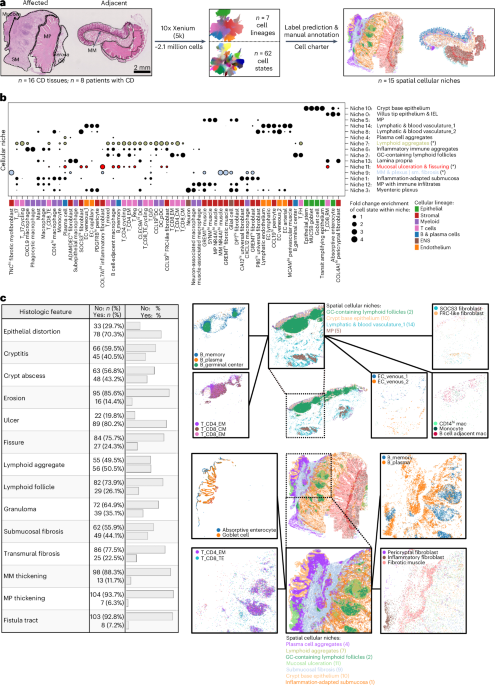
The paper maps distinct stromal cell states tied to inflamed versus fibrotic tissue niches in Crohn’s disease and shows that these states have different chromatin configurations and drug-modifiable properties — pointing...